Filter
11
Featured
6
Topics
2
2
2
2
2
1
1
1
1
1
1
1
1
1
1
1
1
1
1
1
1
1
1
1
1
1
1
1
1
1
1
1
1
Language
Document type
2
1
1
Countries / Regions
Authors & Publishers
Media focus
Publication Years
Methods applied
Journals
Output Type
The Life and Death of SNET, Havana’s Alternative Internet
Rest of World, October 8 (2023)
"[...] in 2011, a group of more than 100 Havana residents decided to unify their hyperlocal networks into a larger structure. The Havana “street network” (or SNET) would soon become one of the largest such community networks in the world. At its peak, user estimates hovered around 100,000 IP add
...

Addressing Hate Speech and Racism in the Media in the Southern Mediterranean: A Review of Formal and Informal Regulatory Approaches
MedMedia (2018), 46 pp.
"This report looks at media practices and regulatory tools that are available to address hate speech and racism in the media, with a focus on eight countries, namely Algeria, Egypt, Lebanon, Jordan, Morocco, Palestine and Tunisia. The first part looks at regulatory approaches to addressing these pro
...
The Global Encyclopaedia of Informality: Understanding Social and Cultural Complexity
London: UCL Press (2018), 2 vols.
"The informal practices revealed in this book include emotion-driven exchanges (from gifts or favours to tribute for services), values-based practices of solidarity and belonging enacting multiple identities, interest-driven know-how (from informal welfare to informal employment and entrepreneurship
...
Communications, Power and Governance in Democratisation Conflicts
Media, Conflict and Democratisation (MeCoDEM) (2017), 37 pp.
"This paper explores the role of digital and traditional media in shaping formal and informal leaders’ interactions with their own constituencies and a broader audience, by both advancing their messages and narratives and manoeuvring to steer a specific political agenda. It specifically considers
...
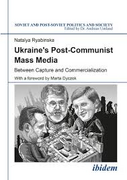
Ukraine's Post-Communist Mass Media: Between Capture and Commercialization
Stuttgart: ibidem-Verlag (2017), 174 pp.
"In the period after the fall of communism, peculiar new obstacles to media independence have arisen. They include the telltale structure of media ownership, with news reporting being concentrated in the hands of politically engaged business tycoons, the fuzzy and contradictory legislation of the me
...

‘It is a Crime to be Abusive Towards the President’: A Case Study on Media Freedom and Journalists’ Autonomy in Museveni's Uganda
African Journalism Studies, volume 37, issue 3 (2016), pp. 1-18
"Using the case of the hybrid media system of Uganda and Schimank’s approach of agent-structure dynamics, this article argues that media freedom and journalists’ autonomy first and foremost depend on society’s expectations of the media system. Closely linked to those informal structures of exp
...
Media, Conflict, and Political Transitions in Africa
In: Media and Politics in New Democracies: Europe in a Comparative Perspective
Oxford et al.: Oxford University Press (2015), pp. 289-302
"In this chapter, we explore the role of the media in the context of Africa's broader democratization trends through an examination of three main areas: the media as political actors in conflict; the challenge of looking beyond formal state structures to informal governance in order to better unders
...

Towards a Diagnostic Approach to Media in Fragile States: Examples from the Somali Territories
Media, War & Conflict, volume 6, issue 3 (2013), pp. 279-293
"Media interventions by international organizations and NGOs in conflict and post-conflict situations seek to develop and shape a media system to contribute to specific political and social ends. The analyses and assessments that inform these interventions are often based on an overview of the forma
...