Filter
28
Featured
18
1
1
Topics
4
4
3
3
3
2
2
2
2
2
2
2
2
2
2
2
1
1
1
1
1
1
1
1
1
1
1
1
1
1
1
1
1
1
1
1
1
1
1
1
1
1
1
1
1
1
1
1
1
1
1
1
1
1
1
1
1
1
1
1
1
1
1
1
1
1
1
1
1
1
1
1
1
1
1
1
1
1
1
1
1
1
Language
Document type
2
2
1
1
1
1
1
Countries / Regions
Authors & Publishers
Media focus
Publication Years
Methods applied
Journals
Output Type
Critiquing Generative AI in Africa's Media Ecosystems
London; New York: Routledge (2026), 215 pp.
"The book argues that as technology is a social construct reflecting existing power dynamics, those in the Global South, and in Africa in particular, are bound to be marginalised and have their knowledge, systems overlooked as the Global North dominates technological developments. The birth of AI ha
...
Journalism and the Muslim Narrative: Power, Resistance and Change
London; New York: Routledge (2025), 183 pp.
"Journalism and the Muslim Narrative presents an empirical analysis of how modern-day journalism practices contribute to the negative bias against Muslims in Britain, to provide an in-depth investigation of how we can better re-conceptualise journalism for our increasingly multicultural societies. F
...
The geopolitics of human suffering: a comparative study of media coverage of the conflicts in Yemen and Ukraine
Third World Quarterly, volume 45, issue 1 (2024), pp. 24-42
"A Saudi-led coalition of states initiated an on-going-armed conflict in Yemen on 26 March 2015. Meanwhile, Russia invaded Ukraine on 24 February 2022. Though no two armed conflicts are exactly alike, there is reason to compare US media coverage of the two because: (1) civilians have been victims of
...

Unearned prestige: How The Economist covers the war in Ukraine
Media Development, issue 4 (2024), pp. 24-30
"The newspaper’s sense of what the story is about influences who is considered qualified and appropriate to quote. Conversely, quotes are blocks that build and legitimize the narrative; they are all the more important in a journal, like The Economist (TE), not known for doing investigative journal
...
Revealing Media Bias in News Articles: NLP Techniques for Automated Frame Analysis
Cham: Springer (2023), xiii, 238 pp.
"This open access book presents an interdisciplinary approach to reveal biases in English news articles reporting on a given political event. The approach named person-oriented framing analysis identifies the coverage's different perspectives on the event by assessing how articles portray the person
...
Media Framing of Political Protests: Reporting Bias and the Discrediting of Political Activism
Post-Soviet Affairs, volume 38, issue 4 (2022), pp. 312-328
"Recently several European countries shifted to illiberalism and made attempts to dominate the media and political narratives. The question we raise is how media populism in Hungary contributes to the buttressing of the regime by discrediting protests. We offer a four-level media analysis. First, we
...

There Can be Only One Truth: Ideological Segregation and Online News Communities in Ukraine
Global Media and Communication, volume 17, issue 2 (2021), pp. 167-187
"The paper examines ideological segregation among Ukrainian users in online environments, using as a case study partisan news communities on Vkontakte, the largest online platform in post-communist states. Its findings suggest that despite their insignificant numbers, partisan news communities attra
...

Fragmented, Polarised and Yet Unified: How Local Media Reflect and Transform Ethno-Sectarian Politics in Iraq
Berlin: Media in Cooperation and Transition (MiCT) (2020), 27 pp.
"[...] MiCT conducted a comparative content analysis on coverage of two issues of national concern on eight different Iraqi TV channels in August 2019: (1) the shelling of a PMF-held position near the Balad Air Base in Salahuddin and (2) the lifting of parliamentary immunity of select Members of Par
...
Muslims in the Media: Towards More Tolerance and Diversity
Key Guides
London: Ethical Journalism Network (EJN) (2019)
"This report has been compiled to investigate the ways in which Muslims are portrayed in the media across Europe. It investigates how media report on topics where the problem of anti-Muslim bias often arises, particularly migration and terrorism. The aims of the investigation are to establish the pr
...

Polarisation and the News Media in Europe
European Parliamentary Research Service (EPRS) (2019), 49 pp.
"Across Europe there is as yet little evidence to support the idea that increased exposure to news featuring like-minded or opposing views leads to the widespread polarisation of attitudes. Although some studies have found that both can strengthen the attitudes of a minority who already hold strong
...

Unbias the News: Why Diversity Matters for Journalism
Essen: Correctiv (2019), 221 pp.
"In journalism, white, male, Western voices still dominate and are often privileged over others, which means that we are not getting the whole story, or the most accurate one. At Hostwriter, we asked journalists to tell us about the barriers they face in their field and potential ways to fix them. W
...
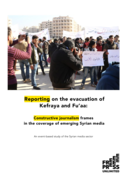
Reporting on the Evacuation of Kefraya and Fu’aa: Constructive Journalism Frames in the Coverage of Emerging Syrian Media
Free Press Unlimited (2019), 15 pp.
"This study presents a snapshot of the framing used in reporting on Syria. To ensure a diverse representation, the sample includes a selection of domestic (Syrian) and pan-Arab media organisations, whose alleged preferences towards the dominant parties in the Syrian conflict are mixed. The findings
...

Publics Globally Want Unbiased News Coverage, But Are Divided on Whether Their News Media Deliver: Deep Political Divides in Many Nations on Satisfaction with News Media
Pew Research Center (2018), 54 pp.
"Publics around the world overwhelmingly agree that the news media should be unbiased in their coverage of political issues, according to a new Pew Research Center survey of 38 countries. Yet, when asked how their news media are doing on reporting different political issues fairly, people are far mo
...

Influencing the Message: The Role of Media Ownership on the Press Coverage of the 2015 Presidential Electoral Campaign in Nigeria
Brazilian Journalism Research, volume 13, issue 3 (2017), pp. 60-85
"This study focuses on the role of media ownership on the press coverage of the 2015 presidential election campaign in Nigeria. Using content analysis, the aim of the study was to identify the themes and examine the direction of the coverage of election campaign news items between the two main polit
...
Refugees, Migration and the Media
Deep Insights
Global Media Journal - German Edition, volume 6, issue 1 (2016), various pag.
"This special issue contains three peer-reviewed articles - on hostile media perceptions in the refugee debate in Germany, the news framing of Lampedusa in the German Süddeutsche Zeitung and the English Guardian, and migration news framing in South Asia and the Pacific -, two essays - on "Compassio
...
Filtering revolution: Reporting bias in international newspaper coverage of the Libyan civil war
Journal of Peace Research, volume 52, issue 3 (2015), pp. 384-400
"Reporting bias – the media's tendency to systematically underreport or overreport certain types of events – is a persistent problem for participants and observers of armed conflict. We argue that the nature of reporting bias depends on how news organizations navigate the political context in wh
...

Reporting Neighbours in Balkan Media
Tirana: Albanian Media Institute (2015), 135 pp.
"This publication opens up a path for dialogue and better mutual understanding among media actors in the various Western Balkan countries. I see its main value in presenting facts and bringing different perspectives together. This is a promising base to further foster bridges between journalists, re
...

Moderation from Bias: A Field Experiment on Partisan Media in a New Democracy
Journal of Politics, volume 77, issue 2 (2015), pp. 575-587
"Partisan media are often blamed for polarization in newly liberalized regimes. However, there is little empirical work on the subject, and information-processing theories suggest that extreme position taking is only one possible response to opinionated news. Rather, we theorize that partisan media
...
Reflections on Elections in a Dominant Party State
African Journalism Studies, volume 36, issue 1 (2015), pp. 149-155
"In my opinion it is too easy to conclude whether eleetion coverage in the media is balanced, solely based on quantitative data. Although this is obviously important, other aspects are equaliy important, particularly in a country such as Mozambique, where the written press does not penetrate much. A
...
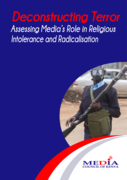
Deconstructing Terror: Assessing Media’s Role in Religious Intolerance and Radicalisation
Nairobi: Media Council of Kenya (2014), xiii, 52 pp.
"The study examined various sampled media content and interviewed key informants to understand professional and ethical considerations informing media coverage of terror, religious extremism and radicalisation. From the findings, it is evident that the media somehow contributes to the propagation of
...