Filter
181
Featured
167
2
5
Topics
31
28
27
27
23
22
20
15
11
10
9
8
7
6
6
6
5
5
5
4
4
4
4
4
4
4
4
4
3
3
3
3
3
3
3
3
3
3
3
2
2
2
2
2
2
2
2
2
2
2
2
2
2
2
2
2
2
2
2
2
2
1
1
1
1
1
1
1
1
1
1
1
1
1
1
1
1
1
1
1
1
1
1
1
1
1
1
1
1
1
1
1
1
1
1
1
1
1
1
1
1
1
1
1
1
1
1
1
1
1
1
1
1
1
1
1
1
1
1
1
1
1
1
1
1
1
1
1
1
1
1
1
1
1
1
1
1
1
1
1
1
1
1
1
1
1
1
1
1
1
1
1
1
1
1
1
1
1
1
1
1
Language
Document type
32
15
10
7
5
2
2
1
1
1
1
1
1
1
Countries
Authors & Publishers
Media focus
Publication Years
Methods applied
Journals
Output Type
The Right to Blog
London: Article 19 (2013), 48 pp.
"In this policy paper, ARTICLE 19 proposes a set of recommendations to state actors and policy makers about what they should do to promote and protect the rights of bloggers domestically and internationally. It also gives practical advice to bloggers about their rights and explains how - and in what
...
Neither Here Nor There: Turkmenistan's Digital Doldrums
Ottawa: SecDev Group (2012), 21 pp.
"Turkmenistan is slowly emerging from decades of darkness. President Gurbanguli Berdymukhamedov has vowed to modernize the country by encouraging the uptake of new technology for economic development and more ef!cient governance. Hundreds of thousands of Turkmen citizens are now online. However, the
...

The Digital Public Domain: Foundations for an Open Culture
Cambridge: Open Book Publishers (2012), xxv, 220 pp.
"Digital technology has made culture more accessible than ever before. Texts, audio, pictures and video can easily be produced, disseminated, used and remixed using devices that are increasingly user-friendly and affordable. However, along with this technological democratization comes a paradoxical
...
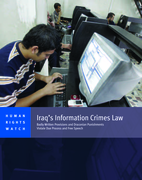
Iraq’s Information Crimes Law: Badly Written Provisions and Draconian Punishments Violate Due Process and Free Speech
New York et al.: Human Rights Watch (2012), 15 pp.
"Iraq’s parliament is in the process of enacting an “Information Crimes Law” to regulate the use of information networks, computers, and other electronic devices and systems. The draft law includes vague provisions that would allow Iraqi authorities to deter legitimate criticisms of or peacefu
...
Freedoms in Iraq: An Increasingly Repressive Legal Net
Washington, DC: IREX; Centre for Law and Democracy (CLD) (2011), 41 pp.
"This report reviews five pieces of legislation affecting the freedoms of assembly and expression that have been introduced in recent years in Iraq. Of these, only one, the Journalists Rights Law (Journalist Law), has actually been passed into law, in August 2011. The other four – the draft Commis
...

Study of Legal Provisions and Practices Related to Freedom of Expression, the Free Flow of Information and Media Pluralism on the Internet in the OSCE Participating States
Vienna: OSCE Representative on Freedom of the Media (2010), 37 pp.
"Today, many OSCE participating States are reacting to the availability and dissemination of certain types of (illegal or unwanted) content through the Internet by trying to regulate or control its dissemination. There is particularly major concern about the availability of terrorist propaganda, rac
...
Understanding Cybercrime: A Guide for Developing Countries. Draft April 2009
Geneva: ITU, ICT Applications and Cybersecurity Division (2009), 225 pp.
"The Guide contains six main chapters. After an Introduction (Chapter 1) the Guide provides an overview of the phenomena of cybercrime (Chapter 2). This includes descriptions of how crimes are committed and explanations of the most widespread cybercrime offences such as hacking, identity theft and d
...
Global Information Society Watch 2009: Focus on Access to Online Information and Knowledge – Advancing Human Rights and Democracy
Association for Progressive Communications (APC); Hivos (2009), 231 pp.
"GISWatch has three interrelated goals: surveying the state of the field of information and communications technology (ICT) policy at local and global levels; encouraging critical debate; strengthening networking and advocacy for a just, inclusive information society. Each year the report focuses on
...

Frequently Asked Questions About Multi-Stakeholder Partnerships in ICTs for Development: A Guide for National ICT Policy Animators
Association for Progressive Communications (APC) (2007), 31 pp.
"Partnerships between the public sector, the private sector and particularly civil society in promoting information and communication technology (ICT) policy are a relatively new venture. The mechanisms, management and governance of such partnerships, from loose arrangements to more formal mechanism
...
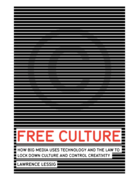
Free Culture: How Big Media Uses Technology and the Law to Lock Down Culture and Control Creativity
New York: Penguin Press (2004), xvi, 345 pp.
"Lawrence Lessig shows us that while new technologies always lead to new laws, never before have the big cultural monopolists used the fear created by new technologies, specifically the Internet, to shrink the public domain of ideas, even as the same corporations use the same technologies to control
...
"The important balance between access to copyrighted works and protection for authors is vital for developing countries and LDCs. Despite provisions for limitations and exceptions to the rights granted to authors/ owners of protected works, the WIPO treaties represent minimum standards from which co
...
Internet und Politik in Lateinamerika: Kuba
Frankfurt am Main: Vervuert (2002), 81 pp.
Internet und Politik in Lateinamerika: Mexiko
Frankfurt am Main: Vervuert (2002), 75 pp.
Internet und Politik in Lateinamerika: Argentinien
Frankfurt am Main: Vervuert (2002), 129 pp.