
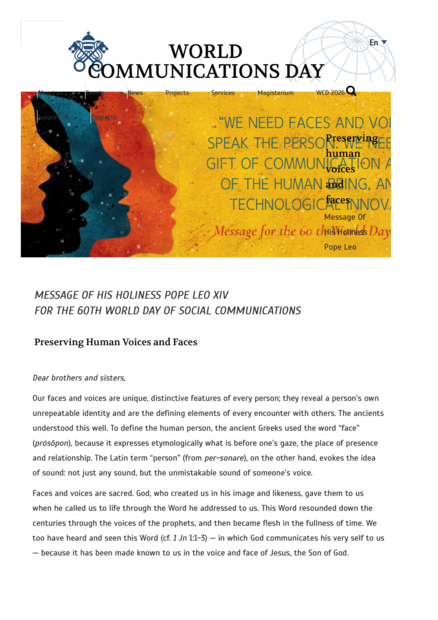
Preserving Human Voices and Faces. Message of his Holiess Pope Leo XIV for the 60th World Day of Social Communication
Vatican City: Holy See, January 24 (2026)
"The task laid before us is not to stop digital innovation, but rather to guide it and to be aware of its ambivalent nature. It is up to each of us to raise our voice in defense of human persons, so that we can truly assimilate these tools as allies. This alliance is possible, but needs to be based on three pillars: responsibility, cooperation and education. First of all, responsibility. Depending on the role we play, responsibility can be understood as honesty, transparency, courage, farsightedness, the duty of sharing knowledge or the right to be informed. As a general principle, however, no one can elude personal responsibility for the future we are building. For those at the helm of online platforms, this means ensuring that their business strategies are not guided solely by the criterion of profit maximization, but also by a forward-looking vision that considers the common good, just as each of them cares for the well-being of their own children. The creators and developers of AI models are invited to practice transparency and socially responsibility in regard to the design principles and moderation systems underlying their algorithms and the models they develop, in order to promote informed consent on the part of users. The same responsibility is also required of national legislators and supranational regulators, whose task it is to ensure respect for human dignity. Appropriate regulation can protect individuals from forming emotional attachments to chatbots and curb the spread of false, manipulative or misleading content, safeguarding the integrity of information as opposed to its deceptive simulation.
[...] We are all called upon to cooperate. No sector can tackle the challenge of steering digital innovation and AI governance alone. Safeguards must therefore be put in place. All stakeholders — from the tech industry to legislators, from creative companies to academia, from artists to journalists and educators — must be involved in building and implementing informed and responsible digital citizenship.
Education aims to do precisely this: To increase our personal ability to think critically; evaluate whether our sources are trustworthy and the possible interests behind selecting the information we have access to; to understand the psychological mechanisms involved; and to enable our families, communities and associations to develop practical criteria for a healthier and more responsible culture of communication. For this reason, it is increasingly urgent to introduce media, information and AI literacy into education systems at all levels, as already promoted by some civil institutions. As Catholics, we can and must contribute to this effort, so that individuals — especially young people — can acquire critical thinking skills and grow in freedom of spirit. This literacy should also be integrated into broader lifelong learning initiatives, reaching out to older adults and marginalized members of society, who often feel excluded and powerless in the face of rapid technological change. Media, information and AI literacy will help individuals avoid conforming to the anthropomorphizing tendencies of AI systems, and enable them to treat these systems as tools and always employ external validation of the sources provided by AI systems — which could be inaccurate or incorrect. Literacy will also allow for better privacy and data protection through increased awareness of security parameters and complaint options." (https://www.comunicazione.va/en/giornata-mondiale-comunicazioni-sociali/gmcs-2026/gmcs-2026-messaggio.html)
[...] We are all called upon to cooperate. No sector can tackle the challenge of steering digital innovation and AI governance alone. Safeguards must therefore be put in place. All stakeholders — from the tech industry to legislators, from creative companies to academia, from artists to journalists and educators — must be involved in building and implementing informed and responsible digital citizenship.
Education aims to do precisely this: To increase our personal ability to think critically; evaluate whether our sources are trustworthy and the possible interests behind selecting the information we have access to; to understand the psychological mechanisms involved; and to enable our families, communities and associations to develop practical criteria for a healthier and more responsible culture of communication. For this reason, it is increasingly urgent to introduce media, information and AI literacy into education systems at all levels, as already promoted by some civil institutions. As Catholics, we can and must contribute to this effort, so that individuals — especially young people — can acquire critical thinking skills and grow in freedom of spirit. This literacy should also be integrated into broader lifelong learning initiatives, reaching out to older adults and marginalized members of society, who often feel excluded and powerless in the face of rapid technological change. Media, information and AI literacy will help individuals avoid conforming to the anthropomorphizing tendencies of AI systems, and enable them to treat these systems as tools and always employ external validation of the sources provided by AI systems — which could be inaccurate or incorrect. Literacy will also allow for better privacy and data protection through increased awareness of security parameters and complaint options." (https://www.comunicazione.va/en/giornata-mondiale-comunicazioni-sociali/gmcs-2026/gmcs-2026-messaggio.html)
Do not renounce your ability to think -- To be or to pretend to be: simulating relationships and reality -- A possible alliance
