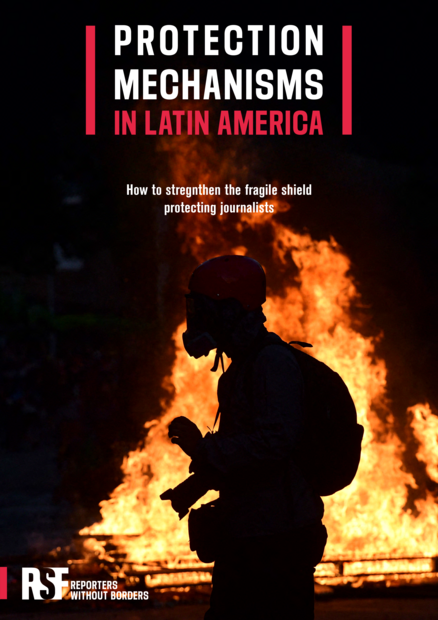
Protection mechanisms in Latin America: How to stregnthen the fragile shield protecting journalists
Paris: Reporters Without Borders (2024), 13 pp.
"Ensuring a safe environment for journalists continues to be a major challenge for Latin America’s democracies. At least 338 journalists have been killed in the region since 2000. These deaths have been compounded by waves of harassment, arbitrary arrests and judicial persecution, which have forced journalists to flee abroad. Due to this systemic violence, protection mechanisms are urgently needed. These statesector programmes aim to protect individuals who are exposed to risks because of their journalistic work or because they combat corruption, organised crime, and abuses carried out by authorities. These initiatives are often launched in response to pressure from civil society and international organisations.
In the past ten years, Colombia, Mexico, Brazil, and Honduras all established such mechanisms. More recently, Ecuador and Peru launched protection initiatives in response to increased attacks. After several administrations that were hostile towards the media,
Guatemala is now also trying to implement a protection policy, while draft laws are being discussed in Chile and Paraguay. Despite national differences, these mechanisms are built around common missions: assessing risks, determining appropriate measures and implementing protection plans for those under state protection. The methods used can take various forms, ranging from regular police patrols and emergency communication channels with law enforcement to enhanced protection measures such as bodyguards, armoured vehicles, bulletproof vests, surveillance cameras, and even relocation to safer places in the most serious situations. With support from UNESCO, Reporters Without Borders (RSF) has worked to strengthen these mechanisms since 2021. In 2022, RSF published a report entitled “Protection paradigm: making protection mechanisms work for Latin American journalists” on Colombia, Mexico, Brazil, and Honduras. Now, this report focuses on the initiatives emerging in Chile, Ecuador, Guatemala, Paraguay, and Peru.
Through this report, RSF reaffirms its commitment — together with civil society and authorities — to establishing concrete responses to the threats against journalists. The number of protection mechanisms are growing, but their efficacy varies considerably and depends on an integrated approach involving various actors in order to prevent violence and ensure that those responsible are brought to justice. Many programmes are cruelly lacking in resources and can offer only limited state support, meaning they often fail to react to threats or prosecute attackers." (Foreword, page 3)
In the past ten years, Colombia, Mexico, Brazil, and Honduras all established such mechanisms. More recently, Ecuador and Peru launched protection initiatives in response to increased attacks. After several administrations that were hostile towards the media,
Guatemala is now also trying to implement a protection policy, while draft laws are being discussed in Chile and Paraguay. Despite national differences, these mechanisms are built around common missions: assessing risks, determining appropriate measures and implementing protection plans for those under state protection. The methods used can take various forms, ranging from regular police patrols and emergency communication channels with law enforcement to enhanced protection measures such as bodyguards, armoured vehicles, bulletproof vests, surveillance cameras, and even relocation to safer places in the most serious situations. With support from UNESCO, Reporters Without Borders (RSF) has worked to strengthen these mechanisms since 2021. In 2022, RSF published a report entitled “Protection paradigm: making protection mechanisms work for Latin American journalists” on Colombia, Mexico, Brazil, and Honduras. Now, this report focuses on the initiatives emerging in Chile, Ecuador, Guatemala, Paraguay, and Peru.
Through this report, RSF reaffirms its commitment — together with civil society and authorities — to establishing concrete responses to the threats against journalists. The number of protection mechanisms are growing, but their efficacy varies considerably and depends on an integrated approach involving various actors in order to prevent violence and ensure that those responsible are brought to justice. Many programmes are cruelly lacking in resources and can offer only limited state support, meaning they often fail to react to threats or prosecute attackers." (Foreword, page 3)
Protecting journalists: Policies hampered by political reluctance in Ecuador, Chile, Guatemala, Paraguay, and Peru, 5
Impactful state policies: Ten key requirements for an effective mechanism to protect journalists, 11
Impactful state policies: Ten key requirements for an effective mechanism to protect journalists, 11