
Filter
60
Breadcrumb:
INTRAC
Featured
56
2
Topics
8
7
6
6
5
4
3
3
2
2
2
2
2
2
1
1
1
1
1
1
1
1
1
1
1
1
1
1
1
1
1
1
1
1
1
1
1
1
1
1
1
1
1
1
1
1
1
1
1
1
1
1
1
1
1
1
1
1
1
1
1
1
Language
Document type
46
3
3
2
2
1
1
Countries
Authors & Publishers
Media focus
Publication Years
Output Type
Aggregation and Summarisation
INTRAC (2019), 7 pp.
"CSOs sometimes need to summarise or aggregate information across multiple interventions. This can be a difficult and challenging task, especially for large non-governmental organisations (NGOs) working in many different countries and/or sectors. Summarisation and aggregation can be achieved through
...
Impact Assessment
INTRAC (2017), 5 pp.

Tracer Studies
INTRAC (2017), 3 pp.
"In a tracer study, data is collected and analysed repeatedly over time. For monitoring and evaluation purposes, tracer studies are often designed to track changes at individual level, following a development intervention. However, they might also focus on other units of analysis such as communities
...
Quasi-Experimental Approaches
INTRAC (2017), 6 pp.
"Experimental approaches work by comparing changes in a group that receives a development intervention with a group that does not. The difference is then attributed to the intervention. In a full experimental approach, units are randomly allocated to two groups – one that receives the intervention
...
Participatory Evaluation
INTRAC (2017), 3 pp.
"A participatory evaluation actively involves key stakeholders, especially the intended beneficiaries of a project or programme, in the design and implementation of the evaluation. Participatory evaluations can be carried out for many reasons. The two most common are to empower beneficiaries to bett
...

Monitoring
INTRAC (2017), 6 pp.
"Monitoring is the systematic and continuous collection and analysis of information about the progress of a development intervention. Monitoring is done to ensure that all the people who need to know about an intervention are properly informed, and so that decisions can be taken in a timely manner.
...

Secondary Data Sources
INTRAC (2017), 2 pp.
"Sometimes, information is used for planning, monitoring or evaluation that has previously been collected by other people or organisations for their own purposes. This is known as secondary data. There are many potential sources of secondary data. Secondary data can be used at any stage of a project
...
Surveys and Questionnaires
INTRAC (2017), 5 pp.
"Surveys and questionnaires are designed to collect and record information from multiple people, groups or organisations in a consistent way. Surveys and questionnaires can be used on their own as data collection tools. They are also an essential part of some more complex data collection and analysi
...
Process Tracing
INTRAC (2017), 5 pp.
"Process tracing is a qualitative analysis methodology. The main purpose of process tracing is to establish whether, and how, a potential cause or causes influenced a specified change or set of changes. This is done by applying formal tests to examine the strength of evidence linking potential cause
...

Real-Time Evaluation
INTRAC (2017), 3 pp.
"A real-time evaluation (RTE) is designed to provide immediate (real time) feedback to those planning or implementing a project or programme, so that they can make improvements. This feedback is usually provided during the evaluation field work, rather than afterwards. RTEs are normally associated w
...
Utilisation-Focused Evaluation
INTRAC (2017), 2 pp.
"Utilisation-focused evaluations (UFEs) are based on the principle that an evaluation should be judged according to how useful it is. UFEs should be planned and implemented in a way that increases the likelihood of the findings being used. This normally means identifying the primary users of an eval
...
Contribution Analysis
INTRAC (2017), 4 pp.
"Contribution analysis is a methodology used to identify the contribution a development intervention has made to a change or set of changes. The aim is to produce a credible, evidence-based narrative of contribution that a reasonable person would be likely to agree with, rather than to produce concl
...

"To understand the changes brought about by a project or programme it is first necessary to understand what the original situation was. This is known as the baseline. Baselines can range from simple data collection exercises through to large, expensive surveys. They are an important part of many M&E
...
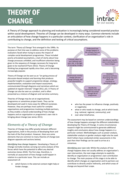
Theory of Change
INTRAC (2017), 4 pp.
"A Theory of Change approach to planning and evaluation is increasingly being considered essential practice within social development. Theories of Change can be developed in many ways. Common elements include an articulation of how change happens in a particular context, clarification of an organisa
...
Programme Indicators
INTRAC (2017), 4 pp.
"Some programme indicators are designed to be collected at programme level. Others are designed to capture, summarise or aggregate information collected at project or partner level. It is important to clarify how information on indicators is transmitted between different levels of a programme." (Int
...

Gender-Responsive Evaluation
INTRAC (2017), 3 pp.
"A gender-responsive evaluation includes two main components. It assesses the degree to which gender and power relationships change as a result of an intervention. And it ensures that women’s voices are prominent throughout the evaluation. Gender-responsive evaluations can be used to evaluate any
...
Qualitative Comparative Analysis
INTRAC (2017), 5 pp.
"Qualitative Comparative Analysis (QCA) is a methodology that enables the analysis of multiple cases in complex situations. It can help explain why change happens in some cases but not others. QCA is designed for use with an intermediate number of cases, typically between 10 and 50. It can be used i
...
"Sampling is a process that enables information to be collected from a small number of individuals or organisations within a project or programme, and then used to draw conclusions about a wider population. There are many different sampling methods. Quantitative analysis tends to require large, rand
...
Outcome Harvesting
INTRAC (2017), 5 pp.
"Outcome harvesting is a monitoring and evaluation methodology used to identify, describe, verify and analyse the changes brought about through a development intervention. It is designed to collect evidence of change, and then work backwards to assess contribution to that change. It was partly inspi
...
