
Filter
30
Breadcrumb:
Papoutsaki, Evangelia
Featured
14
1
Topics
7
7
3
3
3
2
2
2
2
2
2
2
1
1
1
1
1
1
1
1
1
1
1
1
1
1
1
1
1
1
1
1
1
1
1
1
1
1
1
1
1
1
1
1
1
1
1
1
1
1
1
1
1
1
1
1
1
1
1
1
1
1
1
1
1
1
1
1
1
1
1
1
1
1
1
1
1
1
Language
Document type
6
4
2
1
1
1
Countries
Authors & Publishers
Media focus
Publication Years
Methods applied
Journals
Output Type
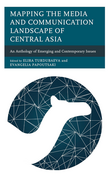
Mapping the Media and Communication Landscape of Central Asia: An Anthology of Emerging and Contemporary Issues
Lexington Books (2023), xiii, 365 pp.
"Central Asian post-independence media and communication industries, professional practices, education, persisting and evolving values, and traditions remain critically understudied with a notable scarcity of research and scholarly publications on the complex and increasingly changing communicative
...

Catalysing Social Change in Ho Chi Minh City, Vietnam: Evaluating the LIN Model of Participatory Community Development
Community Development Journal, volume 54, issue 3 (2019), pp. 519-540
"In communication for social change, a catalyst can play an important role in creating dialogue within the community, leading to collective actions and providing solutions for common problems. In urban communities of developing countries, this role is more essential because of the complexities of ur
...
Engaging youth in community action research: A visual methods approach to HIV and AIDS awareness
Whanake: the Pacific Journal of Community Development, volume 4, issue 2 (2018), pp. 48-66
"Young people are among the most affected and vulnerable groups in the HIV epidemic. Targeting young people in prevention strategies requires inclusive and participatory approaches. This paper discusses a film production project that involved youths in a remote rural community in the Highlands of Pa
...

Mapping Small Islands Communicative Ecologies: A Case Study from the Amami Islands
South Pacific Studies, volume 39, issue 1 (2018), pp. 25-49
"This paper provides a conceptual framework for an islands’ communication ecology (CE) approach and an overview of the key findings of exploratory ethnographic research that aimed at mapping the CE of the Amami islands. The communicative ecology approach refers to the various forms, resources, act
...
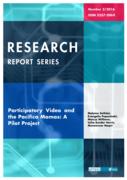
Participatory Video and the Pacifica Mamas: A Pilot Project
Auckland: Unitec Institute of Technology (2016), 20 pp.
"Emerging literature highlights that in the Pacific, the use of participatory video (PV) is a new trend in research and community action. It can be employed as a tool to empower communities to have agency over their media outputs, meaning that they have full control of the content creation, producti
...

A Review of the Pacific Media Landscape: A Baseline Study
Asia Pacific Media Educator, volume 26, issue 2 (2016), pp. 270-287
"This article draws upon the Pacific Media Assistance Scheme (PACMAS) State of Media and Communication Report to examine the implications of a changing media landscape for journalism practice in the Pacific region. The report contributes to an understanding of the diverse media and communications en
...

Relational Accountability in Indigenizing Visual Research for Participatory Communication
Sage Open (2016), 11 pp.
"This article argues that an indigenous approach to communication research allows us to re-think academic approaches of engaging in and evaluating participatory communication research. It takes as its case study the Komuniti Tok Piksa project undertaken in the Highlands of Papua New Guinea. The proj
...

Locating Disaster Communication in Changing Communicative Ecologies Across the Pacific
Australian Journal of Telecommunications and the Digital Economy (AJTDE), volume 2, issue 4 (2014), 16 pp.
"According to ITU statistics, around 60 percent of Pacific Islanders had access to a mobile in 2012, compared to just 10 percent in 2006. In many Pacific countries mobile phones are, therefore, emerging as a key element of the local communication systems, and are being be built into disaster managem
...
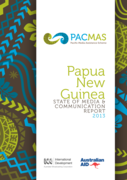
"The research for this report was developed and undertaken between June 2012 and April 2013 across 14 Pacific Island nations: Cook Islands, Federated States of Micronesia, Fiji, Kiribati, Republic of the Marshall Islands, Republic of Nauru, Niue, Republic of Palau, Papua New Guinea, Samoa, Solomon I
...
Mining for Information in Ok Tedi: Communication for Sustainable Development
In: Communication, Culture & Society in Papua New Guinea: Yu Tok Wanem?
Madang: DWU Press, Divine Word University (2011), pp. 135-144
Radio Madang: Tuned in for Development?
In: Communication, Culture & Society in Papua New Guinea: Yu Tok Wanem?
Madang: DWU Press, Divine Word University (2011), pp. 147-156
"The findings of this research have indicated that Radio Madang [the public service broadcaster in Madang province] is an appropriate medium for disseminating information and messages on development issues to people in rural areas of Madang province. With an audience of about 200,000 throughout the
...
Reporting Family Violence: 'Just Another Incident'
In: Communication, Culture & Society in Papua New Guinea: Yu Tok Wanem?
Madang: DWU Press, Divine Word University (2011), pp. 74-82
"The findings from this stuy indicate that the Papua New Guinea (PNG) press is not helping to highlight and address the issue of family violence, which is a social hindrance to development in PNG. This is supported by arguments of lack of prominence given to family violence stories, unreliable sourc
...
Early Experiences of Mobile Telephony: A Comparison of Two Villages in Papua New Guinea
In: Communication, Culture & Society in Papua New Guinea: Yu Tok Wanem?
Madang: DWU Press, Divine Word University (2011), pp. 157-169
Communication, Culture & Society in Papua New Guinea: Yu Tok Wanem?
Madang; Auckland: DWU Press, Divine Word University; Pacific Media Centre, Auckland University of Technology (2011), xi, 235 pp.
Facing the Dragon: The Case of Basamuk and Kurumbakare People in the Ramu Nickel Project
In: Communication, Culture & Society in Papua New Guinea: Yu Tok Wanem?
Madang: DWU Press, Divine Word University (2011), pp. 125-134
"This research looks at the distribution of balanced and accurate information about one of China's biggest investments in the South Pacific region, the Ramu Nickel Project. Are the local people in the project impact areas of Kurumbukare and Basamuk well informed and do they have a voice that is fair
...
Tok Bilong Ol Grassruts: Tok Pisin & Wantok
In: Communication, Culture & Society in Papua New Guinea: Yu Tok Wanem?
Madang; Auckland: DWU Press, Divine Word University; Pacific Media Centre, Auckland University of Technology (2011), pp. 48-61
"Tok Pisin [one of the three national languages] has played a significant role as an agent of change and development in Papua New Guinea. It bridged the gap between the rural and the urban communities and brought confidence to people who are now able to communicate with others as well as among thems
...
Factors Influencing HIV/AIDS Media Awareness Campaigns: A Western Highlands Case Study
In: Communication, Culture & Society in Papua New Guinea: Yu Tok Wanem?
Madang: DWU Press, Divine Word University (2011), pp. 92-102
Our Neighbour's View: Australian Media Coverage of Papua New Guinea
In: Communication, Culture & Society in Papua New Guinea: Yu Tok Wanem?
Madang: DWU Press, Divine Word University (2011), pp. 62-72
The Campus and the Newsroom: Papua New Guinean Media in Education Profile
In: Communication, Culture & Society in Papua New Guinea: Yu Tok Wanem?
Madang: DWU Press, Divine Word University (2011), pp. 205-217
"A 'typical' Papua New Guinean journalist is more likely to be female (very marginally), single, under the age of 29, with about five years experience, a Tok Pisin [indigenous language] speaker but working on English-language media and to have a university diploma or degree in journalism from either
...
