Filter
62
Featured
49
3
1
Topics
9
7
6
5
4
3
3
3
2
2
2
2
2
2
2
2
2
2
2
2
2
1
1
1
1
1
1
1
1
1
1
1
1
1
1
1
1
1
1
1
1
1
1
1
1
1
1
1
1
1
1
1
1
1
1
1
1
1
1
1
1
1
1
1
1
1
1
1
1
1
1
1
1
1
1
1
1
1
1
1
1
1
1
1
1
1
1
1
1
1
1
1
1
1
1
1
Language
Document type
5
4
3
2
1
1
1
1
1
Countries / Regions
Authors & Publishers
Media focus
Publication Years
Methods applied
Journals
Output Type
The critical online diasporic infosphere and counter-public sustenance in an autocratizing society
Information, Communication & Society, volume 28, issue 9 (2025), pp. 1590-1607
"This article conceptualizes the critical online diasporic infosphere as an online space constituted by diasporic media, exile media, and overseas-based influencers who share an oppositional orientation toward the home state. The infosphere proffers a constant stream of critical information and pers
...
Kremlin Media Wars: Censorship and Control Since the Invasion of Ukraine
London: Routledge (2025), xiv, 174 pp.
"This unique volume brings together academics of Russian journalism and media with journalists and editors who reported or continue to report on the country, to explore and reflect on the changing landscape for journalists in Russia or covering Russia, and the increasing control exerted by the gover
...
El periodismo nicaragüense está vivo
Bogotá: Friedrich-Ebert-Stiftung (FES), FES Comunicación (2025), 73 pp.
"En este libro, 12 periodistas nicaragüenses exiliados relatan sus historias y su pasión por el periodismo. A pesar del dolor, el desarraigo y la separación familiar continúan su labor informativa, denuncian las agresiones contra la prensa y los abusos a los derechos humanos. Además, presenta u
...
Navigating instability: A five-phase approach to supporting exiled media
Key Guides
Copenhagen: International Media Support (IMS) (2025), 33 pp.
"In recent years, IMS has seen a steady increase in the number of its media partners forced to flee their home countries to avoid persecution and closure as the democratic space globally has shrunk. IMS expects this trend to continue, with “exiled media” becoming the main – and, in some cases,
...
Kulturtätige aus Belarus, Russland und der Ukraine zwischen Diaspora und Exil: Herausforderungen und Potenziale in den 2020er Jahren
Stuttgart: Institut für Auslandsbeziehungen (ifa) (2025), 66 pp.
"Die vorliegende Studie untersucht die Entwicklungen der Diasporagemeinschaften aus Osteuropa, die in Deutschland und seinen östlichen EU-Nachbarländern seit 2020 an Größe und Bedeutung gewinnen – bedingt durch politische Krisen und Repressionen im autokratisch regierten Belarus und Russland u
...

Gespiegelte Wirklichkeit: 'Osteuropa' und Öffentlichkeit im Wandel
Osteuropa, volume 75, issue 1-3 (2025), 472 pp.
"Der 100. Jahrestag von 'Osteuropa' bietet allerdings Anlass, in drei Bereichen das Verhältnis von Osteuropa und Öffentlichkeit zu analysieren. Der erste ist ein kritischer Blick auf die Geschichte und Gegenwart der Zeitschrift. Seit ihrer Gründung bewegt sich Osteuropa an der Grenze zwischen Wis
...

Flight and Fight: Supporting Exiled Media to Survive and Sustain
London: Internews (2024), 63 pp.

‘Journalism in another form’: How exile experiences from Burundi renegotiate key elements of journalism
Media, War & Conflict, volume 18, issue 2 (2024), pp. 273-294
"Since the renewed outbreak of the ongoing crisis in Burundi in May 2015, triggering a media crackdown, over one-third of the country’s reporters have gone into exile. They therefore joined an increasing number of journalists worldwide who are forced into exile. Between 2015 and 2021, many of the
...

Expat Afghan Media and Local Media amidst Taliban Constraints
International Journal of Social Science and Humanities Research, volume 12, issue 1 (2024), pp. 141-149
"This research study delves into the intricate landscape of media in Afghanistan after 15 August 2021, focusing on the coexistence of local and Expat Afghan Media within the challenging context of Taliban constraints. In the wake of the Taliban's resurgence and control of Afghanistan, The challengin
...
Locking down the windows: A new phase in the fight for press freedom in Russia
Berlin: JX Fund (2024), 43 pp.
"For Russian civil society as well as for Western reporting independent exiled media are playing a central role: These media are a unique and precious voice that can still make its way to Russian audiences. They are also the foundation of Western reporting on Russia – without them, many internatio
...
Structuring Exiled Journalism in a More Authoritarian World
Mediation: Biannual Publication of Fondation Hirondelle, issue 13 (2024), 6 pp.
"Hundreds of endangered journalists living in authoritarian or conflict countries are forced into exile each year. And the phenomenon is growing. How can we organize collectively to protect them, help them recover and keep on doing their job from the host country?" (Page 1)
Bound by Exile: Exploring Kinship Dynamics and Role Perceptions among Diaspora Journalists
Journalism Studies (2024), 20 pp.
"The escalating dangers journalists face globally have led to a marked increase in media professionals seeking safety away from their home countries. As a result, journalists are increasingly forced to choose between silence and survival, with many opting for the latter in the form of diaspora reloc
...
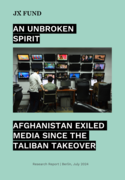
An unbroken spirit: Afghanistan exiled media since the Taliban takeover
Deep Insights
Berlin: JX Fund (2024), 44 pp.
"A large portion of independent media has relocated to United States of America, Canada, and European countries such as Germany, France, UK, Ireland after the Taliban took over. The teams of many of these outlets operate in a hybrid model with editorial leadership in exile and staff members and free
...
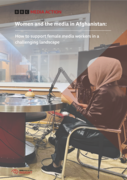
Women and the media in Afghanistan: How to support female media workers in a challenging landscape
London: BBC Media Action (2024), 50 pp.
"Women in Afghanistan continue to have less access to information than men, particularly through TV and the internet. At least 33% of women (more in rural areas) rely on family as a key source of information, while men prioritise other information sources. Yet Afghan women’s information needs have
...
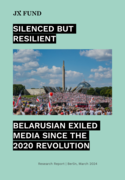
Silenced But Resilient: Belarusian Exiled Media since the 2020 Revolution
Berlin: JX Fund (2024), 45 pp.
Breaking newsrooms: Are Myanmar’s exiled journalists getting a fair deal?
Frontier Myanmar, September 9 (2024)
"Journalists are allegedly suffering exploitation and abuse at exiled news outlets, but there’s debate over whether the responsibility to respond falls on donors or a media industry that is taking gradual steps to self-regulate." (Introduction)