Filter
49
Featured
16
Topics
12
12
9
9
7
5
5
5
4
4
3
3
3
3
3
2
2
2
2
2
2
2
2
2
2
2
2
2
2
1
1
1
1
1
1
1
1
1
1
1
1
1
1
1
1
1
1
1
1
1
1
1
1
1
1
1
1
1
1
1
1
1
1
1
1
1
1
1
1
1
1
1
1
1
1
1
1
1
1
1
1
1
1
1
1
1
1
1
1
1
1
1
1
Language
Document type
16
3
1
Countries / Regions
Authors & Publishers
Media focus
Publication Years
Methods applied
Journals
Output Type
Armenian Media System Overview According to the Hallin and Mancini Model
Media and Communication, volume 12, issue 7850 (2024), 16 pp.
"An overview of the Armenian media system is presented from the perspective of media professionals. Interference with the media system by the political system is analysed and the health of the Armenian media system is explored in the context of its transition from a Soviet republic towards a liberal
...
Public Television in Poland: Political Pressure and Public Service Media in a Post-communist Country
London; New York: Routledge (2021), vi, 132 pp.
"This book examines the professional activity of public television journalists in Poland operating in the still unstable system of a post-communist state, to demonstrate how the media can work in the public interest to strengthen democracy. Drawing on in-depth interviews with Telewizja Polska (TVP)
...
Comparing Post-Socialist Media Systems: The Case of Southeast Europe
Routledge (2021), xvii, 301 pp.
"This book explains divergent media system trajectories in the countries in southeast Europe, and challenges the presumption that the common socialist experience critically influences a common outcome in media development after democratic transformations, by showing different remote and proximate co
...
Polarized Media – Polarized Audience
Ljubljana: South East European Network for Professionalization of Media (SEENPM) (2021), 30 pp.
"A significant number of the surveyed citizens consider the media in Serbia under the control of political groups at both ends of the spectrum. At the same time, many of the surveyed citizens think that the media is free to collect and publish information on all the relevant issues. These findings r
...
Les transformations postsoviétiques des médias et du journalisme russes
Paris: L'Harmattan (2020), 232 pp.
"Existe-t-il un chemin particulier d’ouverture d’un système médiatique à l’économie, aussi épineux soit-il ? C’est justement le fil rouge de cette monographie, qui examine, sur la base de données empiriques et théoriques, les processus de transformation du journalisme et des médias d
...

"Due to its Soviet past, the Russian influence in the Republic of Moldova is still very significant. The country is divided between European integration and Russian convergence. After the government of the pro-European coalition ACUM leaded by Maia Sandu and the pro-Russian Party of Socialists (PSRM
...

Between the White House and the Kremlin: A Comparative Analysis of Afghan and Tajik Media
International Journal of Communication, volume 13 (2019), pp. 619-641
"In their postwar, postindependence, and post-Soviet moments, why did two neighbors, Afghanistan and Tajikistan, who share cultural, linguistic, and historical similarities, take radically divergent paths in the development of their mass media, public sphere, and democracy? In this article, I argue
...
Mass Media in the Post-Soviet World: Market Forces, State Actors, and Political Manipulation in the Informational Environment After Communism
Stuttgart: ibidem-Verlag (2018), 446 pp.
"This collection covers the major trends of the media environment of the post-Communist world and their recent development, with special focus on Russia and the post-Soviet space. The term ‘media environment’ covers not just traditional print and electronic media, but new media as well, and rang
...
From Media Systems to Media Cultures: Understanding Socialist Television
Cambridge: Cambridge University Press (2018), xiii, 369 pp.
"[The authors] delve into the fascinating world of television under communism, using it to test a new framework for comparative media analysis. To understand the societal consequences of mass communication, the authors argue that we need to move beyond the analysis of media systems, and instead focu
...

Media in Process: Transformation and Democratic Transition
Milton Park; New York: Routledge (2017), viii, 184 pp.
"The integration of traditionally isolated Central/ Eastern Europe into larger, worldwide trends has fundamentally changed the way we look at the media in this region. This volume proposes to address the transition of the media and communication industries in the contemporary period. The contributio
...
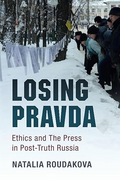
Losing Pravda: Ethics and the Press in Post-Truth Russia
Cambridge: Cambridge University Press (2017), xi, 265 pp.
"Combining ethnography, media analysis, moral and political theory this book examines the unravelling of professional journalism in Russia over the past twenty-five years, and its effects on society. It argues that, contrary to widespread assumptions, late Soviet-era journalists shared a cultural co
...
The death of B92: How it survived Milosevic’s authoritarianism but didn’t survive democracy
International Journal of Digital Television, volume 8, issue 2 (2017), pp. 261-276
"This article examines how broadcaster B92, once the top-billed independent media in Serbia that resisted Milosevic’s authoritarianism, could not survive democracy. Although it withstood the crackdown and censorship of the war regime, it was eventually sunk by what could be considered ‘market ce
...
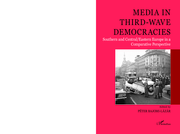
Media in Third-Wave Democracies: Southern and Central/Eastern Europe in a Comparative Perspective
Paris; Budapest: L'Harmattan (2017), 238 pp.
"The media and political systems of former communist countries in Central/Eastern Europe share a number of similarities with those in Southern Europe. According to Karol Jakubowicz, these similarities also include late democratisation, a weak middle class, marked social and economic differences, a s
...
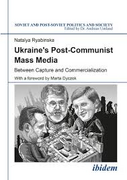
Ukraine's Post-Communist Mass Media: Between Capture and Commercialization
Stuttgart: ibidem-Verlag (2017), 174 pp.
"In the period after the fall of communism, peculiar new obstacles to media independence have arisen. They include the telltale structure of media ownership, with news reporting being concentrated in the hands of politically engaged business tycoons, the fuzzy and contradictory legislation of the me
...
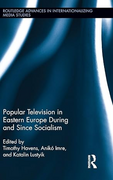
Popular Television in Eastern Europe During and Since Socialism
London: Routledge (2015), xi, 285 pp.
Journalists' Perceptions of Nomenklatura Networks and Media Ownership in Post-Communist Bulgaria
Medijske Studije / Media Studies, volume 6, issue 11 (2015), pp. 19-33
"This article discusses the role of the former communist party elite (the nomenklatura) in the Bulgarian post-communist media landscape in relation to media ownership and the origin of media outlets’ capital. The spotlight is on Bulgarian journalists’ perceptions examined through semi-structured
...
Secrets, lies, and journalist-spies: The contemporary moral dilemma for Bulgarian media professionals
International Journal of Press/Politics, volume 20, issue 2 (2015), pp. 185-203
"The subject of this article is the issue of journalist-spies in the Bulgarian media before and after the fall of communism in 1989. The focus is on the perceptions of Bulgarian journalists on the role alleged secret service collaborators played, and continue to play, in the postcommunist society an
...
Party Colonisation of the Media in Central and Eastern Europe
Budapest et al.: Central European University Press (2014), vi, 273 pp.
"The author argues that differences in media freedom and in the politicization of the news media are rooted in differences in party structures between old and new democracies, and, notably, the fact that young parties in the new members of the European Union are short of resources, which makes them
...
A Critique of the Systems Approaches in Comparative Media Research: A Central and Eastern European Perspective
Global Media and Communication, volume 9, issue 3 (2013), pp. 257-277
"This article looks critically at the systems approaches in comparative media studies when applied to studying the relationship between media and politics in Central and Eastern Europe (CEE). It introduces a concept of methodological systematization consisting of four different components: (1) the r
...