
Filter
160
Breadcrumb:
Center for International Media Assistance (CIMA)
Featured
159
20
1
Topics
26
12
11
10
9
9
8
7
7
7
7
7
7
6
6
6
5
5
5
5
5
4
4
4
4
4
4
4
4
4
4
3
3
3
3
3
3
3
3
3
3
3
3
3
3
3
3
3
3
3
2
2
2
2
2
2
2
2
2
2
2
2
2
2
2
2
2
2
2
2
2
2
2
2
2
2
2
2
2
2
2
2
2
2
2
2
2
2
2
2
2
2
2
2
2
2
2
2
1
1
1
1
1
1
1
1
1
1
1
1
1
1
1
1
1
1
1
1
1
1
1
1
1
1
1
1
1
1
1
1
1
1
1
1
1
1
1
1
1
1
1
1
1
1
1
1
1
1
1
1
1
1
1
1
1
1
1
1
1
1
1
1
1
1
1
1
1
1
1
1
1
1
1
1
1
1
1
1
1
1
1
1
1
1
1
1
1
1
1
1
1
1
1
1
1
1
1
1
1
1
1
1
1
1
1
1
1
1
1
1
1
1
1
1
1
1
1
1
1
1
1
1
1
1
1
1
1
1
1
1
1
1
1
1
1
1
1
1
1
1
1
Language
Document type
49
17
9
8
2
2
1
1
Countries
Authors & Publishers
Media focus
Publication Years
Methods applied
Output Type
Bigger Cities, Smaller Screens: Urbanization, Mobile Phones, and Digital Media Trends in Africa
Washington, DC: Center for International Media Assistance (CIMA) (2012), 36 pp.
"As Africa becomes increasingly urban, the reach and use of mobile telephones and other portable digital devices inevitably are becoming a mass medium. This shift creates new opportunities for existing broadcasters and publishers. And it creates new opportunities for a much larger number of new inde
...
Is There a Link Between Media and Good Governance? What the Academics Say
Washington, DC: Center for International Media Assistance (CIMA) (2012), 45 pp.
"From this short survey of some key thinkers, can we conclude that there is a causal link between media and good governance? Does the existence of a free media increase accountability and reduce corruption? Do media influence society in positive ways and liberate the individual? As one would expect,
...
A Pilot Study for GFMD’s Media Development Toolkit: Testing Standards, Strengthening Professionalism. An Assessment of Ghana’s Media Landscape
Washington, DC: Center for International Media Assistance (CIMA); IREX; Global Forum for Media Development (GFMD) (2012), 49 pp.
"The study did not aim to carry out new surveys or collect information that was not already publicly available. Since the toolkit is aimed at providing media development organizations with a tool to assess media landscapes without having to carry out extensive new research, the Ghana study worked on
...

The Video Revolution
Washington, DC: Center for International Media Assistance (CIMA) (2012), 43 pp.
"Citizen journalists across the globe are using blogs, Twitter, Facebook, YouTube, and other new tools to spread articles, blog posts, videos, and photos of news happening in their countries. The new video journalists use these broader tools as well, taking full advantage of social media to share th
...
Making Media Development More Effective
Washington, DC: Center for International Media Assistance (CIMA) (2012), 42 pp.
"Despite years of stock taking, donors to media development still have a number of blind spots that prevent their interventions from being more effective. In particular, media development stakeholders could improve their efforts by applying aid effectiveness principles to their practice. When examin
...
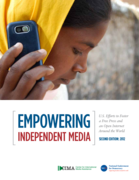
Empowering Independent Media: U.S. Efforts to Foster a Free Press and an Open Internet Around the World
Deep Insights
Washington, DC: Center for International Media Assistance (CIMA), 2nd ed. (2012), 149 pp.
"This report examines seven central areas of media development—funding, digital media, sustainability, media law, journalists' safety, journalism education, and monitoring and evaluation. It also delves in-depth into four areas deserving of greater attention: citizen journalism, investigative jour
...
Challenges for Independent News Media in Pakistan
Washington, DC: Center for International Media Assistance (CIMA) (2012), 47 pp.
"For two years running, Pakistan has been ranked by international media monitors as the most dangerous place on earth for journalists. Media workers have been kidnapped, tortured, and beaten to death for delving into the nation’s potent military apparatus and spy agencies. Bodies have been found w
...
Content Analysis: Can Shared Indicators Improve Monitoring and Evaluation?
Washington, DC: Center for International Media Assistance (CIMA) (2012), 24 pp.
Digital Media in the Arab World: One Year After the Revolutions
Washington, DC: Center for International Media Assistance (CIMA) (2012), 31 pp.
"Following the revolutions, the battle for the Arab blogosphere has turned from being a competition over accessing the Internet and circumventing government controls to a cyberwar for the predominant narrative through Facebook, Twitter, and traditional media [...] Social media is reinvigorating trad
...
Covering Elections: The Challenges of Training the Watchdogs
Washington, DC: Center for International Media Assistance (CIMA) (2012), 36 pp.
"Covering elections is not just coverage of one “grand event,” and training must reflect that. Short-term training just in advance of election day has been mostly discounted as ineffective. More must be done to cast elections as part of a critical on-going political process and to equip journali
...
Confronting the News: The State of Independent Media in Latin America
Washington, DC: Center for International Media Assistance (CIMA) (2011), 38 pp.
"Over time the governments of Nicaragua, Venezuela, Bolivia, and Ecuador have shown a growing willingness to shrug off even the harshest criticism from usually friendly forums such as the OAS and UNESCO. As the media is forced into silence and the independence of the judiciary is weakened, there are
...
Independent Media in Exile
Deep Insights
Washington, DC: Center for International Media Assistance (CIMA) (2011), 43 pp.
"This report offers four recommendations for addressing some of the complex challenges of independent media in exile: donor groups should expand and formalize coordination of their exile-media support [...]; organizations providing international media training should actively seek to train exile-med
...
Media Codes of Ethics: The Difficulty of Defining Standards
Washington, DC: Center for International Media Assistance (CIMA) (2011), 48 pp.
Social Media in the Arab World: Leading Up to the Uprisings of 2011
Washington, DC: Center for International Media Assistance (CIMA) (2011), 39 pp.
"Key Findings: About 17 million people in the Arab region are using Facebook, available in Arabic, with 5 million in Egypt alone, and demand is expected to grow on micro-blogging sites. Twitter announced it will launch its Arabic interface in 2011; Arab governments are developing, at varying rates,
...
Continental Shift: New Trends in Private U.S. Funding for Media Development
Washington, DC: Center for International Media Assistance (CIMA) (2011), 26 pp.
"This work is an update of the October 2009 CIMA report, Experimentation and Evolution in Private U.S. Funding of Media Development by the same author. The field of private sector funding of independent media abroad has continued to undergo a massive upheaval over the past two years. Both the 2008 r
...
Caught in the Middle: Central and Eastern European Journalism at a Crossroads
Washington, DC: Center for International Media Assistance (CIMA) (2011), 93 pp.
"Particularly as journalism transitions to new digital, mobile, and Internet formats, Central and Eastern European countries need to experiment with new business and usage models and find strong advocates for independent media. Instead, the current economic, political and social momentum is pushing
...
Matching the Market and the Model: The Business of Independent News Media
Washington, DC: Center for International Media Assistance (CIMA) (2011), 34 pp.
"According to this paper, many media businesses lack management skills and experience in developing effective business models. "Compounding this is a lack of media development assistance targeted to media managers, the expansion of economic constraints on media businesses, and a lack of access to in
...
