
Filter
25
Breadcrumb:
Dragomir, Marius
Featured
22
3
Topics
7
4
4
4
3
3
3
2
2
2
2
2
2
2
1
1
1
1
1
1
1
1
1
1
1
1
1
1
1
1
1
1
1
1
1
1
1
1
1
1
1
1
1
1
1
1
1
1
Language
Document type
4
4
1
1
1
Countries
Authors & Publishers
Media focus
Publication Years
Methods applied
Journals
Output Type

The Architecture of Media Capture: Typologies, Global Patterns, and the Tech Threat
Tallinn; London: Media Journalism Research Center (MJRC) (2026), 29 pp.
"Media capture, the systematic subordination of news media to the political and commercial interests of ruling elites, has become one of the defining governance crises of the 21st century. Where the 20th century’s threats to press freedom were primarily those of outright censorship and state-contr
...
Buying time, not markets: The limits of donor funding in Hungary’s captured media system
Journalism (2026), 20 pp.
"Independent journalism faces converging pressures from media capture, volatile donor priorities, and platform-driven markets accelerated by generative AI. This article presents 5 years (2020–2025) of first-hand evidence from a donor-funded program to support journalism in Hungary that combined co
...
Funding Without Strings: The Case for IJ4EU’s Investigative Journalism Support Model
Journalism Practice (2025), 19 pp.
"Against the backdrop of market failure, shrinking newsroom budgets, and increasing political pressure on the press, the Investigative Journalism for Europe (IJ4EU) program has emerged as a journalist-led, donor-funded initiative that supports collaborative investigative reporting across borders. Dr
...
Humanitarian Crisis Coverage Report
Tallinn; London: Media and Journalism Research Center (MJRC) (2025), 38 pp.
"The central research question — to what extent media representation aligns with crisis severity — underpins an analysis of 78,667 news articles spanning 10 of the world's most urgent humanitarian crises, from Sudan and Ethiopia to Ukraine and Gaza. Drawing from English-language media in eight c
...


The Capture Effect: How Media Capture Affects Journalists, Markets and Audiences
Central European Journal of Communication, volume 2, issue 36 (2024), pp. 162-184
"As the literature aimed at defining and explaining media capture has grown in recent years so has the interest in documenting the impact of capture in greater depth. There is still a relatively wide gap between the literature focused on defining and describing the concept, which is rich and increas
...
Investing in Facts: How the Business Community Can Support a Healthy Infosphere
Deep Insights
Washington, DC: Center for International Media Assistance (CIMA); Center for International Private Enterprise (CIPE) (2023), 33 pp.
"This report builds off research conducted in Czechia, Romania, and Serbia by an international team of media experts. The research aimed to identify inspiring and impactful ways that the private sector in these countries is engaging in efforts to counter disinformation and bolster independent journa
...
A Framework for Assessing the Role of Public Service Media Organizations in Countering Disinformation
Digital Journalism, volume 10, issue 5 (2022), pp. 843-865
"Public service media (PSM) are widely acknowledged as part of the variety of solutions to disinformation. The remit of PSM, formed around values of universality, equality, diversity, accuracy and quality, implies a responsibility to fight disinformation by producing fact-based news content and find
...
Matriz de influencia de medios: Argentina. Gobierno, política y regulación
Budapest: Center for Media, Data and Society (CMDS) (2022), 35 pp.
"En Argentina la libertad de expresión está garantizada oficialmente desde la sanción de la primera constitución en 1853. Los medios de comunicación operan en un marco formal de libertad, no exenta de presiones por parte del Estado y de los intereses comerciales. La prensa escrita no cuenta con
...

The Debunking Effect: Recent and Upcoming Challenges for Fact-Checking Organizations
Deep Insights
Budapest: Center for Media, Data and Society (CMDS) (2022), 50 pp.
"The CEU Democracy Institute's Center for Media, Data and Society (CMDS) embarked in November 2020 on a one-year project aimed at mapping and analyzing the work of the world's fact-checking groups, with a focus on their challenges, needs and successes. The project started with a survey of 30 fact-ch
...

What Keeps Fact-Checking Organizations Up at Night
Budapest: Center for Media, Data and Society (CMDS) (2021), 15 pp.
"One of the main challenges for fact-checkers seems to be to better and more effectively reach their audience. That means, on the one hand, improved skills and capacity to reach out to a specific group of followers, but also techniques to more efficiently use social media as an audience generation t
...
Media Influence Matrix: Jordan. Technology, Public Sphere and Journalism
Budapest: Center for Media, Data and Society (CMDS) (2021), 28 pp.
"As for internet use, the percentage of the population with access to internet rose to 89% in 2019 from 48% in 2015. Access to a mobile phone and internet in Jordan has become a matter of choice rather than affordability or accessibility. The Syrian refugee crisis explains the overshooting in mobile
...

Media Influence Matrix: Slovakia
Budapest: Center for Media, Data and Society (CMDS), 2nd, updated ed. (2020), 110 pp.
"Seemingly, Slovaks have access to a wealth of news sources. In reality, though, the market is concentrated in the hands of a few large players. Powerful financial groups such as Penta Investments and J&T, and a handful of magnates including Ivan Kmotrik and Andrej Babis (who is also Czech Republicâ
...
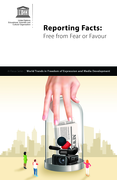
Reporting Facts: Free from Fear or Favour
Paris: UNESCO (2020), 52 pp.
"In a growing number of countries around the world, the greatest menace to editorial independence and professional standards is media capture, a form of media control achieved through a series of premeditated steps taken by governments and powerful interest groups, which undermines journalism as a p
...

Media Capture in Europe
Media Development Investment Fund (MDIF) (2019), 25 pp.
"The collusion between the political class and media owners [in Central and Eastern Europe] has reached unprecedented levels, leading to a phenomenon known as media capture, a situation where most or all of the news media institutions are operating as part of a government-business cartel that contro
...
