
Filter
114
Breadcrumb:
Reuters Institute for the Study of Journalism
Featured
110
5
Topics
17
16
16
12
8
7
7
6
5
5
4
4
4
4
4
4
4
3
3
3
3
3
3
3
3
3
3
3
3
3
3
3
2
2
2
2
2
2
2
2
2
2
2
2
2
2
2
2
2
2
2
2
2
2
2
2
2
2
2
1
1
1
1
1
1
1
1
1
1
1
1
1
1
1
1
1
1
1
1
1
1
1
1
1
1
1
1
1
1
1
1
1
1
1
1
1
1
1
1
1
1
1
1
1
1
1
1
1
1
1
1
1
1
1
1
1
1
1
1
1
1
1
1
1
1
1
1
1
1
1
1
1
1
1
1
1
1
1
1
1
1
1
1
1
1
1
1
1
1
1
1
1
1
1
1
1
1
1
1
1
1
1
1
1
1
1
1
1
1
1
1
1
1
1
1
1
1
1
1
1
1
1
1
1
Language
Document type
12
4
3
2
2
1
1
1
Countries
Authors & Publishers
Media focus
Publication Years
Methods applied
Output Type
Unlocking the Investigative Potential of Freedom of Information Acts
Oxford: Reuters Institute for the Study of Journalism (2021), 27 pp.
"Experts say having a law for access to public information is important to enhance public transparency, but it’s only the starting point in the battle against state secrecy. How can journalists benefit from such laws and why should the news media care about it? This paper is divided into four part
...
How Journalists Can Address Misinformation on Telegram
Oxford: Reuters Institute for the Study of Journalism (2021), 35 pp.
"As of July 2021, Telegram had 550 million active users worldwide – more than the individual user bases of Twitter, Snapchat or Discord. It is the fifth most-popular messaging app after Facebook-owned Whatsapp and Messenger, and WeChat and QQ which dominate the Chinese market [...] For this paper,
...
How Kenya’s Media Retooled Peer Review to Address Issues of Trust and Quality in News
Oxford: Reuters Institute for the Study of Journalism (2021), 24 pp.
"Self regulation through peer review is a system whereby journalists hold each other accountable for the quality and accuracy of their content. If the Kenyan experience is anything to go by, this measure can provide an additional layer of scrutiny – additional to a state ombudsman or media housesâ
...
An Ongoing Infodemic: How People in Eight Countries Access and Rate News and Information About Coronavirus a Year Into the Pandemic
Oxford: Reuters Institute for the Study of Journalism (2021), 37 pp.
"In almost all countries, news organisations are the single most widely used source of information about coronavirus. Furthermore, news organisations have become even more central to how people stay informed about coronavirus in the last year because, while overall reach has declined compared to ear
...
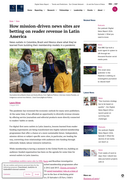
How Mission-Driven News Sites Are Betting on Reader Revenue in Latin America: News Outlets in Colombia, Brazil and Mexico Share What They’ve Learned from Building Their Membership Models in the Midst of a Pandemic
Oxford: Reuters Institute for the Study of Journalism (2021)
"For digital-first news outlets in Latin America, lessons learned from reader-funding experiments are being transformed into highly tailored membership programmes that offer a chance at a more sustainable future. Independent, mission-driven or subject-specific news sites, in particular, are leading
...
Overcoming Indifference: What Attitudes Towards News Tell Us About Building Trust
Oxford: Reuters Institute for the Study of Journalism (2021), 69 pp.
"This report contains a range of findings about news audiences in each of the four countries [Brazil, India, United Kingdom, United States], focusing on audiences overall as well as different segments of the public categorised according to their degree of trust towards news brands in their country.
...
Digital Audience Revenue Strategies in CEE and the Global South
Oxford: Reuters Institute for the Study of Journalism (2021), 57 pp.
"This study provides encouraging evidence that digital audience revenue programmes – donation drives, crowdfundings, membership schemes or subscriptions – may be a viable option for independent media outlets operating in challenging political environments. Responses from 19 outlets operating in
...

Digital News Report 2021
Oxford: Reuters Institute for the Study of Journalism (2021), 163 pp.
"This year's report reveals new insights about digital news consumption based on a YouGov survey of over 92,000 online news consumers in 46 markets including India, Indonesia, Thailand, Nigeria, Colombia and Peru for the first time. The report looks at the impact of coronavirus on news consumption a
...
How to Build a Successful Subscription News Business: Lessons from Britain and Spain
Oxford: Reuters Institute for the Study of Journalism (2020), 79 pp.
"The paper explores what news companies with reader revenue models are doing through structured interviews with 26 media executives from 15 news organisations. Some of these outlets run digital subscriptions. Others have reader revenue models with a less transactional value proposition. Most of them
...
Few Winners, Many Losers: The COVID-19 Pandemic’s Dramatic and Unequal Impact on Independent News Media
Oxford: Reuters Institute for the Study of Journalism (2020), 31 pp.
"This report presents findings from an analysis of 165 responses to a survey of a strategic sample of known and identified independent news media organisations on how the COVID-19 pandemic has impacted them, combined with interviews with a critical sample of seven independent news media operating in
...
Navigating the ‘infodemic’: How People in Six Countries Access and Rate News and Information About Coronavirus
Oxford: Reuters Institute for the Study of Journalism (2020), 34 pp.
"In this report, we use survey data collected in late March and early April 2020 to document and understand how people in six countries (Argentina, Germany, South Korea, Spain, the UK, and the US) accessed news and information about COVID-19 in the early stages of the global pandemic, how they rate
...

Digital News Report 2020
Oxford: Reuters Institute for the Study of Journalism (2020), 111 pp.
"The bulk of this report is based on data collected by a survey of more than 80,000 people in 40 markets and reflects media usage in January/February just before the coronavirus hit many of these countries. But the key trends that we document here, including changes in how people access news, low tr
...
How Free is Ghana’s Media?
Oxford: Reuters Institute for the Study of Journalism (2020), 15 pp.
What We Think We Know and What We Want to Know: Perspectives on Trust in News in a Changing World
Oxford: Reuters Institute for the Study of Journalism (2020), 26 pp.
"Trust in news has eroded worldwide. According to the Reuters Institute’s Digital News Report 2020, fewer than four in ten people (38%) across 40 markets say they typically trust most news. While trust has fallen by double digit margins in recent years in many places, including Brazil and the Unit
...

Types, Sources, and Claims of COVID-19 Misinformation
Oxford: Reuters Institute for the Study of Journalism (2020), 13 pp.
"In this RISJ factsheet we identify some of the main types, sources, and claims of COVID-19 misinformation seen so far. We analyse a sample of 225 pieces of misinformation rated false or misleading by factcheckers and published in English between January and the end of March 2020, drawn from a colle
...
Women and News: An Overview of Audience Behaviour in 11 Countries
Deep Insights
Oxford: Reuters Institute for the Study of Journalism (2020), 43 pp.
"This report [...] presents a bespoke analysis of how women around the world consume and perceive news, based on data on audience behaviour from 11 countries featured in the 2020 Reuters Institute Digital News Report: Kenya, South Africa, South Korea, Hong Kong, Japan, Mexico, Brazil, Finland, Germa
...

Women and Leadership in the News Media 2020: Evidence from Ten Markets
Oxford: Reuters Institute for the Study of Journalism (2020), 6 pp.
"In this RISJ factsheet we analyse the gender break-down of top editors in a strategic sample of 200 major online and offline news outlets in ten different markets across four continents. Looking at a sample of ten top online news outlets and ten top offline news outlets in each of these ten markets
...
How Young People Consume News and the Implications for Mainstream Media
Deep Insights
Oxford: Reuters Institute for the Study of Journalism (2019), 63 pp.
"Younger audiences are different from older groups not just in what they do, but in their core attitudes in terms of what they want from the news. Young people are primarily driven by progress and enjoyment in their lives, and this translates into what they look for in news. They still need and want
...

Keeping it Local: Can Collaborations Help Save Local Public Interest Journalism?
Oxford: Reuters Institute for the Study of Journalism (2019), 72 pp.
"This research paper looks at the responsibilities of, and opportunities for, major media organisations to collaborate with regional and suburban media to break stories, cover local issues and promote democracy and asks how a collaborative model can practically work for journalists. Despite the angs
...
The Evolving Indian Media Market: Succeeding Through Localisation
Oxford: Reuters Institute for the Study of Journalism (2019), 44 pp.
"India, with about 1.3 billion people, has a teledensity of 91% with 1.7 billion mobile connections and 700 million unique subscribers. There are 525 million internet users led by mobile internet. Mobile, therefore, is now the primary screen in India. It is disrupting media consumption patterns as i
...
