
Filter
1129
Breadcrumb:
UNESCO
Featured
871
46
44
Topics
69
64
56
53
48
37
36
36
35
35
32
31
30
29
29
28
27
27
26
26
25
24
23
21
20
18
18
18
18
18
17
17
16
15
15
15
15
15
14
14
14
14
14
13
13
13
13
13
12
12
12
12
12
12
12
11
11
11
11
11
11
10
10
10
10
10
9
9
9
9
9
9
9
9
9
9
9
9
9
8
8
8
8
8
8
8
8
8
8
8
7
7
7
7
7
7
7
7
7
7
7
7
7
7
6
6
6
6
6
6
6
6
6
6
6
6
6
6
6
6
6
6
6
6
6
6
6
5
5
5
5
5
5
5
5
5
5
5
5
5
5
5
5
5
5
5
5
5
5
5
5
5
5
5
5
5
5
5
5
5
5
5
5
5
5
5
4
4
4
4
4
4
4
4
4
4
4
4
4
4
4
4
4
4
4
4
4
4
4
4
4
4
4
4
4
4
4
4
4
4
4
4
4
4
4
4
4
4
4
4
4
4
4
4
4
4
4
4
4
4
4
4
4
4
4
4
4
4
4
3
3
3
3
3
3
3
3
3
3
3
3
3
3
3
3
3
3
3
3
3
3
3
3
3
3
3
3
3
3
3
3
3
3
3
3
3
3
3
3
3
3
3
3
3
3
3
3
3
3
3
3
3
3
3
3
3
3
3
3
3
3
3
3
3
3
3
3
3
3
3
3
3
3
3
3
3
3
3
3
3
3
3
3
3
3
3
3
3
3
3
3
3
3
3
3
3
3
2
2
2
2
2
2
2
2
2
2
2
2
2
2
2
2
2
2
2
2
2
2
2
2
2
2
2
2
2
2
2
2
2
2
2
2
2
2
2
2
2
2
2
2
2
2
2
2
2
2
2
2
2
2
2
2
2
2
2
2
2
2
2
2
2
2
2
2
2
2
2
2
2
2
2
2
2
2
2
2
2
2
2
2
2
2
2
2
2
2
2
2
2
2
2
2
2
2
2
2
2
2
2
2
2
2
2
2
2
2
2
2
2
2
2
2
2
2
2
2
2
2
2
2
2
2
2
2
2
2
2
2
2
2
2
2
2
2
2
2
2
2
2
2
2
2
2
2
2
2
2
2
2
2
2
2
2
2
2
2
2
2
1
1
1
1
1
1
1
1
1
1
1
1
1
1
1
1
1
1
1
1
1
1
1
1
1
1
1
1
1
1
1
1
1
1
1
1
1
1
1
1
1
1
1
1
1
1
1
1
1
1
1
1
1
1
1
1
1
1
1
1
1
1
1
1
1
1
1
1
1
1
1
1
1
1
1
1
1
1
1
1
1
1
1
1
1
1
1
1
1
1
1
1
1
1
1
1
1
1
1
1
1
1
1
1
1
1
1
1
1
1
1
1
1
1
1
1
1
1
1
1
1
1
1
1
1
1
1
1
1
1
1
1
1
1
1
1
1
1
1
1
1
1
1
1
1
1
1
1
1
1
1
1
1
1
1
1
1
1
1
1
1
1
1
1
1
1
1
1
1
1
1
1
1
1
1
1
1
1
1
1
1
1
1
1
1
1
1
1
1
1
1
1
1
1
1
1
1
1
1
1
1
1
1
1
1
1
1
1
1
1
1
1
1
1
1
1
1
1
1
1
1
1
1
1
1
1
1
1
1
1
1
1
1
1
1
1
1
1
1
1
1
1
1
1
1
1
1
1
1
1
1
1
1
1
1
1
1
1
1
1
1
1
1
1
1
1
1
1
1
1
1
1
1
1
1
1
1
1
1
1
1
1
1
1
1
1
1
1
1
1
1
1
1
1
1
1
1
1
1
1
1
1
1
1
1
1
1
1
1
1
1
1
1
1
1
1
1
1
1
1
1
1
1
1
1
1
1
1
1
1
1
1
1
1
1
1
1
1
1
1
1
1
1
1
1
1
1
1
1
1
1
Language
Document type
175
111
99
93
37
37
34
26
22
16
13
9
9
8
7
7
7
7
6
4
3
3
3
2
2
1
1
1
1
1
1
Countries
Authors & Publishers
Media focus
Publication Years
Methods applied
Output Type
UNESCO's Multi-Donor Programme on Freedom of Expression and Safety of Journalists (MDP) Action in Afghanistan: 2018-2021 Quadrennial Report, Country Summaries
Paris: UNESCO (2022), 5 pp.
"To ensure the survival of Afghanistan’s media sector after the regime change, reprogrammed funding from the MDP and the Global Media Defence Fund (GMDF) provided emergency support t o independent Afghan media outlets that had seen their viability disrupted as a result of the crisis. Through this,
...
Assessment of Media Development in Sudan 2019-2020: Based on UNESCO's Media Development Indicators
Paris: UNESCO (2022), 107 pp.
"The research data reveal that Sudan at the time had at least 10 media-related laws in place that do not meet international standards. At the same time, the country had the benefit of an infrastructure of 30 institutions offering media education and training. Sudan has an opportunity to restructure
...
UNESCO's Multi-Donor Programme on Freedom of Expression and Safety of Journalists (MDP) Action in Burundi: 2018-2021 Quadrennial Report, Country Summaries
Paris: UNESCO (2022), 6 pp.
"Burundian authorities have shown promising signs of substantive change by initiating the revision of the disputed 2018 press law, an exercise for which they requested UNESCO’s technical support. UNESCO’s participation in this process was made possible by continuous dialogue between UNESCO and t
...

Content Moderation and Freedom of Expression: Bridging the Gap Between Social Media and Local Civil Society
Article 19; UNESCO (2022), 46 pp.
"This report presents a summary analysis of research on current practices of content moderation in Bosnia and Herzegovina, Indonesia, and Kenya, with a specific focus on 'harmful content' such as 'hate speech' and disinformation. The methodology combined desk research with qualitative interviews wit
...
UNESCO's Multi-Donor Programme on Freedom of Expression and Safety of Journalists (MDP) Action in The Gambia: 2018-2021 Quadrennial Report, Country Summaries
Paris: UNESCO (2022), 5 pp.
"Through the implementation of the MDP, UNESCO has sought to contribute to better democratic governance through improving freedom of the press and the quality of information available to the population in The Gambia. The “Support to Policy Development for Sustainability of Community Media in The G
...
Trends in the Media’s Coverage of Covid-19 in SADC, 1 January - 31 June 2021
Media Monitors; UNESCO (2022), 16 pp.
"This report provides an assessment of the reporting trends in the coverage of COVID-19 in nine SADC countries. The countries are Botswana, Eswatini, Lesotho, Malawi, Mozambique, Namibia, South Africa, Zambia and Zimbabwe. Stories published between 1 January and 30 June 2021 were selected from 38 ne
...
Knowing the Truth is Protecting the Truth: Highlights of the UNESCO Director-General’s Report on the Safety of Journalists and the Danger of Impunity Published on the Occasion of the International Day to End Impunity for Crimes Against Journalists 2022
UNESCO (2022), 15 pp.
"The Report is a unique mechanism within the UN system for monitoring the killings of journalists. It was first published in 2008, upon a Decision of the Intergovernmental Council of the International Programme for the Development of Communication (IPDC). The report is published every two years, mak
...
Assessment of Media Development in The Gambia: Based on UNESCO's Media Development Indicators
Paris: UNESCO (2022), 86 pp.
"Although some planned reforms announced since 2017 concerning the rights to freedom of expression and others are yet to be finalized, the report finds that the media environment has improved considerably since the new government came into power. In the context of a rising internet penetration rate,
...
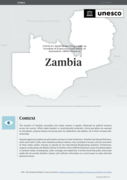
UNESCO's Multi-Donor Programme on Freedom of Expression and Safety of Journalists (MDP) Action in Zambia: 2018-2021 Quadrennial Report, Country Summaries
Paris: UNESCO (2022), 4 pp.
"In an effort to support the smooth running of the 2021 General Elections, Zambia was integrated as a target country under the MDP. In partnership with MISA Zambia, UNESCO supported local journalists and editors to enhance their capacities on mis/disinformation, electoral reporting and safety measur
...
After the Pandemic, Building Back a Stronger Media: Inspiring Initiatives in Ensuring Media Viability
Deep Insights
Paris: UNESCO (2022), 81 pp.
"The pandemic brought to crisis point prior trends facing independent news media, whether online or offline or hybrid. While media became more important than ever for citizens as a source of reliable information in an insecure and continuously changing world, newsrooms struggled to pay their bills.
...
UNESCO's Multi-Donor Programme on Freedom of Expression and Safety of Journalists (MDP) Action in Yemen: 2018-2021 Quadrennial Report, Country Summaries
Paris: UNESCO (2022), 4 pp.
"Yemen was added as a beneficiary country under the MDP in 2020, with the aim of promoting joint and/or coordinated media development actions to reinforce access to information and freedom of expression, both online and offline. However, due to the COVID-19 pandemic, activities had to be postponed t
...
History Under Attack: Holocaust Denial and Distortion on Social Media
Deep Insights
Paris: UNESCO (2022), 68 pp.
"This publication is the first report from UNESCO and the United Nations to specifically address Holocaust denial and distortion. It details the ways in which social media is fertile ground for hate and prejudice - and proposes actions we can take in response. Based on the data of billions of Facebo
...
Empowering Yemeni Youth Towards Peace: Ensuring Access to Information and Participation
Paris: UNESCO (2022), 64 pp.
"UNESCO strived to improve access to information for Yemeni youth through building capacities of young Yemeni journalists to produce content that ensures balanced coverage of the peacebuilding process. The produced content necessitated the development of an information platform to disseminate messag
...
UNESCO's Multi-Donor Programme on Freedom of Expression and Safety of Journalists (MDP) Action in Jordan: 2018-2021 Quadrennial Report, Country Summaries
Paris: UNESCO (2022), 3 pp.
"Jordan was included as a beneficiary country under the MDP in 2021, responding to a request by the country’s Judicial Training Institute to strengthen the capacities of judicial operators on international standards and issues related to freedom of expression and access to information. This collab
...

UNESCO's Multi-Donor Programme on Freedom of Expression and Safety of Journalists (MDP) Action in Morocco: 2018-2021 Quadrennial Report, Country Summaries
Paris: UNESCO (2022), 6 pp.
"The MDP has sought throughout the reporting period to assist in the implementation of Morocco’s new legal framework, while also supporting compliance to international standards. Actions build on previous work such as an agreement signed with the Ministry for the Reform of Public Administration in
...
UNESCO Prizes: Reviews and Renewals. UNESCO/Guillermo Cano World Press Freedom Prize
UNESCO (2022), 10 pp.
"In conformity with Article 8.1 of the Statutes for the UNESCO/Guillermo Cano World Press Freedom Prize and the Revised Overall Strategy for UNESCO Prizes and its Constituent Criteria, an external evaluation of the Prize was carried out from June to July 2022 for the past six years of the Prize (201
...
UNESCO's Multi-Donor Programme on Freedom of Expression and Safety of Journalists (MDP) Regional Action in Latin America and the Caribbean: 2018-2021 Quadrennial Report, Country Summaries
Paris: UNESCO (2022), 10 pp.
"The MDP has since 2018 supported various capacity-building activities for Latin American and Caribbean judicial actors, such as the 5th and 6th edition of the MOOC “International Legal Framework on Freedom of Expression, Access to Public Information and the Safety of Journalists”, additional MO
...

UNESCO's Multi-Donor Programme on Freedom of Expression and Safety of Journalists (MDP) Action in Iraq: 2018-2021 Quadrennial Report, Country Summaries
Paris: UNESCO (2022), 5 pp.
"Iraq was added as a target country under the MDP in 2020, building on the first phase of the “Breaking the Silence: Enhancing Public Accountability on Freedom of Expression and the Safety of Journalists in Iraq” project, which was implemented by UNESCO between 2019 and 2021 with funding from th
...
Assessment of Media Development in Ethiopia: Based on UNESCO's Media Development Indicators
Paris; Addis Ababa: UNESCO (2022), 131 pp.
"In a country like Ethiopia which is rich in languages, politics, cultures, and values and which experiences an exponentially growing population, media and the access to plural information is crucial for peace and development. This study finds, however, that the number of media and the diversity of
...
The Inclusion of Learners with Disabilities: Guidelines on Emergency Movement to Online and Distance Learning
Paris: UNESCO (2022), 32 pp.
"This document addresses open and distance learning (ODL) in a variety of environments where education and learning are increasingly technology mediated, whether it be completely at distance or an increasingly prevalent blended framework where students use technology part of the time. During times o
...
