Filter
56
Featured
49
1
Topics
16
11
10
6
5
5
5
5
4
4
3
2
2
2
2
2
2
2
1
1
1
1
1
1
1
1
1
1
1
1
1
1
1
1
1
1
1
1
1
1
1
1
1
1
1
1
1
1
1
1
1
1
1
1
1
1
1
1
1
1
1
1
Language
Document type
6
5
3
1
1
Countries / Regions
Authors & Publishers
Media focus
Publication Years
Methods applied
Journals
Output Type
Psychological Defence and Information Influence: A Textbook on Theory and Practice
Karlstad: Psychological Defence Agency (2025), 257 pp.
"In an age defined by rapid information flows and shifting security landscapes, the resilience of societies rests not only on military strength or technological capacity, but equally on the ability of individuals and institutions to withstand psychological influence and manipulation. Psychological d
...
Journalists, Social Media and News Consumption
Ukrainian Analytical Digest, issue 16 (2025), 32 pp.
"This issue focuses on journalism and social media in Ukraine. The first two articles examine the safety of journalists in Ukraine during the war based on the Worlds of Journalism Study and assess how the security situation during the war influences the practice of ‘patriotic journalism.’ The fo
...
Digital occupation: Pro-Russian bot networks target Ukraine’s occupied territories on Telegram
Atlantic Council, July 16 (2025)
"This joint report from OpenMinds and the Digital Forensic Research Lab (DFRLab) analyzes the activity of a network of 3,634 automated accounts that posted pro-Russian comments on Telegram channels between January 2024 and April 2025 targeting Ukrainian populations inside Russian-occupied territorie
...
In Eastern Europe, freeze on US aid leaves door open to Russian disinformation
Washington, DC: International Center for Journalists, February 25 (2025)
"The Trump administration’s freeze on U.S. foreign aid will lead to a surge in Russian disinformation across Eastern Europe, experts warn, as independent media outlets across the region will be forced to shutter, leaving a vacuum of credible information in their wake. “Russian disinfo will have
...
Russian information operations outside of the Western information environment
Riga: NATO Strategic Communications Centre of Excellence, Rev. version (2025), 184 pp.
"This report, drawing from research, qualitative and quantitative data, Key Insight Interviews (KIIs), digital tools, and Russian information and deception doctrine, explores the Kremlin’s IIOs in non-Western environments using five selected countries as case studies: Egypt, Mali, Kenya, South Afr
...
"The US has suspended funding for development aid, including for media. Meanwhile, China and Russia have been stepping up media assistance programs for years with a variety of strategies, explains Dani Madrid-Morales." (Introduction)

Russian Public-Diplomacy Efforts to Influence Neighbors: Media Messaging Supports Hard-Power Projection in Ukraine and Georgia
International Journal of Communication, volume 18 (2024), pp. 2661-2684
"Nations use media to disseminate stories about their culture, history, and values. This study explored Russian public-diplomacy efforts by examining news content exported to its neighbors, Ukraine and Georgia, from February 2021 to July 2021, approximately one year before Russia’s invasion of Ukr
...
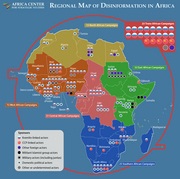
Mapping a Surge of Disinformation in Africa
Washington, DC: Africa Center for Strategic Studies, March 13 (2024)
"Disinformation campaigns have targeted every region of the continent. At least 39 African countries have been the target of a specific disinformation campaign. Disinformation tends to be concentrated. Half of the countries subjected to disinformation (20 of the 39) have been targeted three or more
...
“Voices from the Island”: Informational annexation of Crimea and transformations of journalistic practices
Journalism, volume 25, issue 3 (2024), pp. 528–546
"After the annexation of Crimea by Russia in March 2014, the peninsula experienced a progressive transition of telecommunication and broadcasting infrastructure under Russian influence, followed by a wave of repression of Ukrainian media. Between 2014 and 2015, dozens of Ukrainian media organization
...
Pop-up-Propaganda: Epikrise der russischen Selbstvergiftung. Mit einem illustrierten "Ratgeber für das Überleben"
Berlin: Matthes & Seitz (2024), 337 pp.
"Während innerhalb Russlands das Verbot kritischer Medien und die Gleichschaltung der verstaatlichten Sender eine beinahe karikaturhafte Erzählung über traditionelle Werte und die Notwendigkeit der "Militärischen Spezialoperation" hervorbringen, arbeiten sorgfältig geplante Propagandaaktionen i
...
Two Years On: An Analysis of Russian State and Pro-Kremlin Information Warfare in the Context of the Invasion of Ukraine
London: Institute for Strategic Dialogue (ISD) (2024), 25 pp.
"This report provides an overview of how Russian state and pro-Kremlin propaganda undermining international support for Ukraine has evolved over the two years since the beginning of the full-scale invasion on 24 February 2022. It outlines a range of semi-covert tactics through which Russian state an
...
Digital Disinformation in Africa: Hashtag Politics, Power and Propaganda
London: Zed Books (2024), xiv, 242 pp.
"In an era when hashtag campaigns like #MeToo and #BlackLivesMatter capture global attention for victims of injustice, politicians and corporations are now spending billions employing Cambridge Analytica-type consultancies to manufacture disinformation - employing trolls, cyborgs and bots to disrupt
...

“She Played All the Pregnant Women!”: Russian Disinformation, Symbolic Annihilation, and the Mariupol Hospital Attack
International Journal of Communication, volume 18 (2024), pp. 3730-3751
"On March 9, 2022, the maternity and children’s hospital number 3 in Mariupol, Ukraine, was bombed as part of Russia’s full-scale war efforts in Ukraine. However, Russian statealigned media promoted a different narrative: namely, that the bombing itself, as well as the victims on site, were fake
...
Russia, Disinformation, and the Liberal Order: RT as Populist Pariah
Ithaca, NY: Cornell University Press (2024), 342 pp.
"Through the prism of the first comprehensive account of RT, the Kremlin's primary tool of foreign propaganda, Russia, Disinformation and the Liberal Order sheds new light on the provenance and nature of disinformation's threat to democracy. Interrogating the communications strategies pursued by aut
...
Ein Jahr russischer Angriffskrieg: Die Rolle von Desinformation in Deutschland
Berlin: CeMAS Center für Monitoring, Analyse und Strategie (2023), 26 pp.
"Desinformation begleitet den russischen Angriffskrieg auf die Ukraine und erreicht auch ein deutsches Publikum. Sie dient der Stärkung russischer Propaganda und ist geeignet, die deutsche und europäische Entscheidungs- und Handlungsfähigkeit in Bezug auf den Krieg zu stören und negativ zu beein
...
Humour as a Strategic Tool Against Disinformation: Ukraine’s Response to Russia
Oxford: Reuters Institute for the Study of Journalism (2023), 35 pp.
"Ukraine has been building its capacity to use humour as a strategic communications tool since Russian first invasion in 2014. After Russia launched the full-scale war in February 2022, this often grassroots effort was multiplied by many new actors joining it. Foreign supporters of Ukraine stepped i
...

Exploring Disinformation in Fragile States: Iraq as a Case Study of Influence of International Political Actors
Tokyo: Toda Peace Institute (2023), 18 pp.
"This paper examines the influence of international political actors in perpetuating disinformation in fragile states, using Iraq as a case study. The advent of modern technology and social media has transformed the global information landscape, providing new avenues for the dissemination of disinfo
...

Russia’s Rising Military and Communication Power: From Chechnya to Crimea
Media, War & Conflict, volume 16, issue 2 (2023), pp. 135-152
"Most scholars working on Russia’s use of strategic narratives recognize the importance of the Russian state. Nevertheless, the authors argue that much of the attention on strategic narratives has given insufficient appreciation for how Russia has developed its military and media policies in a coo
...
The War of Narratives: Ukraine’s Image in the Media
Kyiv: LLC «Vistka»; Friedrich-Ebert-Stiftung (FES) (2023), 146 pp.
"In order to spread Russian narratives about Ukraine that create a false impression of the country among external and internal audiences, the Russian Federation uses a whole complex of information and communication channels. Their main task is to replace the target audience's existing ideas about th
...