Filter
297
Featured
177
8
Topics
60
40
27
22
19
15
14
11
10
7
6
6
6
5
5
5
4
4
4
4
3
3
3
3
3
3
3
3
2
2
2
2
2
2
2
2
2
2
2
2
2
2
2
2
2
2
2
2
1
1
1
1
1
1
1
1
1
1
1
1
1
1
1
1
1
1
1
1
1
1
1
1
1
1
1
1
1
1
1
1
1
1
1
1
1
1
1
1
1
1
1
1
1
1
1
1
1
1
1
1
1
1
1
1
1
1
1
1
1
1
1
1
1
1
1
1
1
1
1
1
1
1
1
Language
Document type
47
37
19
14
2
1
1
1
1
Countries / Regions
Authors & Publishers
Media focus
Publication Years
Methods applied
Journals
Output Type
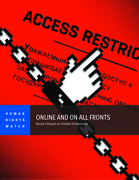
Online and on All Fronts: Russia’s Assault on Freedom of Expression
Human Rights Watch (2017), 84 pp.
"Since 2012, Russian authorities have intensified a crackdown on free expression, treating criticisms of the government as threats to state security and public stability and curbing privacy online. The government has introduced significant restrictions to online expression and invasive surveillance
...
Assessing Indonesian journalist threats: Cases, actors and motives
Media Asia, volume 44, issue 1 (2017), pp. 25-32
"This paper serves as a review of crimes committed against journalist in Indonesia within the past six years (2010–2015). This work draws primarily on the annual reports made by the Alliance of Independence Journalist (AJI), the prominent association of journalists in Indonesia. The first part int
...
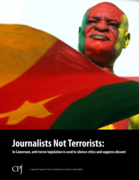
Journalists Not Terrorists: In Cameroon, Anti-Terror Legislation is Used to Silence Critics and Suppress Dissent
New York: Committee to Protect Journalists (CPJ) (2017), 17 pp.
"In 2014, Cameroon enacted a broad anti-terror law as part of its effort to counter the extremist group Boko Haram, but authorities are using it to arrest and threaten local journalists who report on the militants or unrest in the country’s English-speaking regions. A presidential decree in August
...
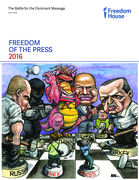
Freedom of the Press 2016: The Battle for the Dominant Message
Washington, DC: Freedom House (2016), 28 pp.
"Global press freedom declined to its lowest point in 12 years in 2015, as political, criminal, and terrorist forces sought to co-opt or silence the media in their broader struggle for power. The share of the world’s population that enjoys a Free press stood at just 13 percent, meaning fewer than
...
"They Can Arrest You at Any Time": The Criminalization of Peaceful Expression in Burma
Human Rights Watch (2016), 87 pp.
"Focusing largely on the period since retired general Thein Sein assumed the presidency in 2011, the report provides an in-depth analysis of the Peaceful Assembly and Peaceful Processions Act, the Telecommunications Act, the News Media Law, the Electronic Transactions Act, and various Penal Code pro
...
Stifling Dissent: The Criminalization of Peaceful Expression in India
Human Rights Watch (2016), 117 pp.
"This report details how the criminal law is used to limit peaceful expression in India. It documents examples of the ways in which vague or overbroad laws are used to stifle political dissent, harass journalists, restrict activities by nongovernmental organizations, arbitrarily block Internet sites
...
On the Need to Amend Chapter XV of the Special Section of the Criminal Code of Ukraine
Journal of Eastern European Law, volume 24 (2016), pp. 57-61
"The article deals with the issue of establishing criminal liability for crimes against journalists. Areas of research on this subject are identified. The basic research and publications on issues are reviewed. The need for introducing such liability is investigated. It is indicated that several spe
...
Donkor: A case study of the safety of journalists in Ghana
Global Media Journal - African Edition, volume 10, issue 2 (2016), pp. 92-120
"This paper argues that the safety of journalists in Ghana can no longer be taken for granted given the available evidence of physical attacks on journalists (Joint Statement NMC et al., 2016 and MFWA, 2016). The overarching objective of the study is to portray Donkor’s case as typical of similar
...
"As we stand now, Pakistan’s media continues its stratospheric expansion, but in the midst of curbs and controls and ongoing safety issues. Nepal, Bhutan and Sri Lanka are treading a precarious path to finding credible and independent spaces for the media against economic challenge and political c
...
Periodismo muerto: Más de mil periodistas asesinados en América Latina (1970-2015)
Deep Insights
México, DF: Editorial Planeta Mexicana (2016), 389 pp.
"Más de 1050 periodistas asesinados y desaparecidos (unos 22,8 casos al año) hicieron de América Latina el escenario más peligroso del mundo para el ejercicio profesional, entre 1970 y 2015, incluso en países sin guerras oficialmente aceptadas. Desde las dictaduras hasta el narcopoder, desde MÃ
...
"Like Fish in Poisonous Waters": Attacks on Media Freedom in Somalia
New York: Human Rights Watch (2016), 85 pp.
"This report focuses on abuses by state and non-state actors against journalists and other media workers since 2014. It is based on over 50 interviews with journalists working throughout south-central Somalia and Puntland, the semi-autonomous state in northeastern Somalia. Beyond killings, attempted
...
Media Freedom Report 2015
Ulaanbaatar: Globe International Center (2016), 23 pp.
"As Good as Dead": The Impact of the Blasphemy Laws in Pakistan
London: Amnesty International (2016), 66 pp.
"This report details how Pakistan’s blasphemy laws violate human rights, both in their substance and their application – whether this is violations of human rights by the state, or abuses of the laws by non-state actors. The laws do not meet human rights standards and lack essential safeguards t
...

The safety of Al Jazeera English journalists in Egypt
Global Media Journal - African Edition, volume 10, issue 2 (2016), pp. 68-91
"The imprisonment of Al Jazeera English (AJE) journalists (Australian Peter Greste, Egyptian-Canadian national Mohamed Fahmy, and Egyptian Baher Mohamed) in Egypt between 2013 and 2015 reflected the recent ten agenda items of the United Nations Educational, Scientific and Cultural Organisation (UNES
...
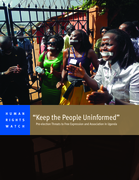
"Keep the People Uninformed": Pre-Election Threats to Free Expression and Association in Uganda
Human Rights Watch (2016), 42 pp.
"[This publication] documents harassment and intimidation by government and ruling party officials against the media and civil society, particularly outside the capital, Kampala. The police, district officials, internal security officials, and the country’s broadcasting regulator visited and calle
...
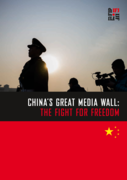
China’s Great Media Wall: The Fight for Freedom
Brussels: International Federation of Journalists (IFJ) (2016), 68 pp.
"Press freedom in China, Hong Kong and Macau deteriorated further in 2015, as the Communist Party of China used every means at its disposal to control the media. Its ultimate target, as always, was to preserve its power in the mainland, extend its influence over Hong Kong and Macau, and tightly mana
...
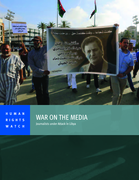
"This report documents attacks against journalists and the offices and facilities of media outlets since the 2011 uprising, including threats, assaults, kidnappings, and killings and addresses the failure of the government to protect journalists and the media, and hold perpetrators of attacks on the
...
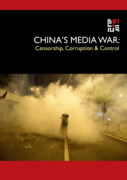
China’s Media War: Censorship, Corruption & Control
Brussels: International Federation of Journalists (IFJ) (2015), 69 pp.
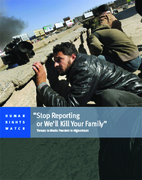
"Stop Reporting or We'll Kill Your Family": Threats to Media Freedom in Afghanistan
New York: Human Rights Watch (2015), 45 pp.
"Afghan journalists face threats from all sides: government officials exploiting weak legal protections to intimidate reporters and editors to compel them not to cover controversial topics; the Taliban and other insurgent groups using threats and violence to compel reporting they consider favorable;
...