Filter
197
Featured
140
6
Topics
25
20
20
18
18
14
14
14
12
10
10
8
8
7
6
6
6
6
5
5
5
5
5
5
4
4
4
4
4
4
4
4
4
4
4
4
3
3
3
3
3
3
3
3
3
3
3
3
3
3
3
3
3
3
3
3
3
3
3
3
3
3
3
3
2
2
2
2
2
2
2
2
2
2
2
2
2
2
2
2
2
2
2
2
2
2
2
2
2
2
2
2
2
2
2
2
2
2
2
2
2
2
2
2
2
2
2
2
2
2
2
1
1
1
1
1
1
1
1
1
1
1
1
1
1
1
1
1
1
1
1
1
1
1
1
1
1
1
1
1
1
1
1
1
1
1
1
1
1
1
1
1
1
1
1
1
1
1
1
1
1
1
1
1
1
1
1
1
1
1
1
1
1
1
1
1
1
1
1
1
1
1
1
1
1
1
1
1
1
1
1
1
1
1
1
1
1
1
1
1
1
1
1
1
1
1
1
1
1
1
1
1
1
1
1
1
1
1
1
1
1
1
1
1
1
1
1
1
1
1
1
1
1
1
1
1
1
1
1
1
1
1
1
1
1
1
1
1
1
1
1
1
1
1
1
1
1
1
1
1
1
1
1
1
1
1
1
1
1
1
1
1
1
1
Language
Document type
44
18
12
9
4
3
2
2
2
1
1
1
1
1
1
Countries / Regions
Authors & Publishers
Media focus
Publication Years
Methods applied
Journals
Output Type
Examining Perceptions Towards War/Peace Journalism: A Survey of Journalists in Iraq, Afghanistan and Pakistan
International Communication Gazette, volume 84, issue 3 (2022), pp. 183-205
"Following seminal study on journalistic attitudes towards wars and peace journalism, in this study we investigated the perceptions of conflict reporters in the three most deadly countries in the world including Iraq, Afghanistan and Pakistan. A total of 317 journalists participated in this study. T
...
Solidarity and Survival: The Story of South Asia. Afghanistan Country Report
International Federation of Journalists (IFJ) (2022), 5 pp.
"An independent media is essential to tell the world the complex unfolding story of Afghanistan. Journalists remaining in Afghanistan, as well as those who have left, desperately need support from the international community. There is need for solidarity and interventions on several fronts. The Afgh
...
UNESCO's Multi-Donor Programme on Freedom of Expression and Safety of Journalists (MDP) Action in Afghanistan: 2018-2021 Quadrennial Report, Country Summaries
Paris: UNESCO (2022), 5 pp.
"To ensure the survival of Afghanistan’s media sector after the regime change, reprogrammed funding from the MDP and the Global Media Defence Fund (GMDF) provided emergency support t o independent Afghan media outlets that had seen their viability disrupted as a result of the crisis. Through this,
...

The Evolution in the Taliban’s Media Strategy
George Washington University, Program on Extremism (2022), 8 pp.
"In the mid-1990s, the Taliban took control of Afghanistan for the first time. They banned photography, TV, music, and all forms of entertainment. Soon after, the Taliban banned the internet in early 2001, and then-Foreign Minister Mawlavi Wakil Ahmad Muttawakil famously stated, “We want to establ
...
Brief No.1: Media Restrictions and the Implications for Gender Equality in Afghanistan
Kabul: UN Women (2022), 29 pp.
"After nearly 20 years of international investment and successful efforts to build a diverse media landscape and strengthen journalism standards, the Afghan media sector has fundamentally changed for the worse since the Taliban (also referred herein to as the de facto authorities) takeover on 15 Aug
...

The Working Conditions and Challenges of Afghan Female Journalists
American Journal of Applied Psychology, volume 11, issue 3 (2022), pp. 90-100
"Journalism is a demanding profession in Afghanistan, where females are less encouraged to become journalists. Even recently, the people of Afghanistan still do not encourage females to work outside. But still, a significant number of females are engaged in journalism. It contributes to society for
...
Afghanistan Media Landscape Guide
CDAC Network (2022), 24 pp.
"This Media Landscape Guide provides a snapshot of the media in Afghanistan, including the audiences, the producers, the preferences of different groups in the community, the communications culture, and the languages associated with the media. It gives an insight into the role of media in developmen
...

Afghanistan's media developments and challenges in the past two decades: A short glance at media freedom
Reality of Politics, issue 19 (2022), pp. 64-77
"Media, during Taliban five years period from 1996–2001, had been totally suffocated. Only limited number of print media would publish to spread the propaganda of Taliban Emirate under Sharia Law. Post-Taliban era, media landscape obtained new image with the establishment of democratic government.
...
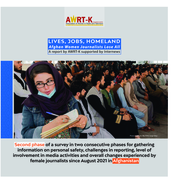
Lives, Jobs, Homeland: Afghan Women Journalists Lose All
Association of Women in Radio and Television (AWRT-K) (2022), 52 pp.
"According to a survey conducted by Reporters without Borders (RSF) in December 2021, from 10,790 people working in Afghan media (8,290 men and 2,490 women) at the start of August 2021, only 4,360 (3,950 men and 410 women) were still working and the number may reduce even further. For this survey, d
...
"Against the backdrop of a highly precarious situation for journalists, a severe economic crisis is unfolding within Afghan media houses, according to a survey on the current state of the media sector in Afghanistan conducted by DW Akademie and partner organizations. Data were collected in February
...
Policy Paper: Unpacking Content Moderation in Pashto and Dari
Meedan; Digital Rights Foundation (DRF) (2022), 25 pp.
"Content moderation at scale is an extremely complicated issue, however by looking at specific examples such as the case studies and data highlighted in this study, the conversation can start to take into account more diverse experiences and context that is normally overlooked. Emerging from these e
...
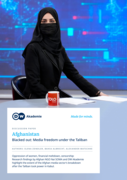
Afghanistan. Blacked Out: Media Freedom Under the Taliban
Bonn: Deutsche Welle DW Akademie (2022), 7 pp.
"Oppression of women, financial meltdown, censorship: Research findings by Afghan NGO Nai SOMA and DW Akademie highlight the extent of the Afghan media sector’s breakdown after the Taliban took power in Kabul." (Page 1)
Transformations in Afghan Media and Culture Through Cycles of Upheaval
Current History, volume 121, issue 834 (2022), pp. 135-140
"This article traces how the Afghan cultural, media, and arts sectors have gone through cycles of boom and bust in tandem with the country’s tumultuous history in recent decades, starting with the prewar golden era in the 1960s and 1970s, then focusing on the post-9/11 internationally funded media
...

Connecting with Homeland: Media Consumption of Afghan Diaspora in India
International Journal of Communication and Media Science, volume 8, issue 2 (2021), 5 pp.
"Afghan presence in India dates back centuries. It exists in the form of goods, language, cultural and political influences, and other subtler yet significant forms. The influx of Afghan students, traders, and medical tourists in India, especially post the 2001 regime change in Afghanistan, has give
...

Afghanistan Media Landscape: Key Results
London: BBC Media Action (2021), 1 p.
"TV is the most popular media platform. Majority of TV viewers and radio listeners watch and listen to those media weekly. Urban, educated and younger people watch TV more than rural, less educated and older people. Men listen to radio and use internet more than women [...] A nationally representati
...
"Written just prior to the Taliban's rapid takeover of Afghanistan, this new report from Shorenstein Center Fellow Samiullah Mahdi provides an overview of the media landscape in Afghanistan, and the threats to and opportunities for press freedom in the region." (Introduction)
The Fall of Kabul: When Platforms Enable Propaganda
Centre for International Governance Innovation, August 27 (2021)
"Social media companies face an increasingly urgent ethical dilemma about the use of their platforms by Taliban officials and supporters." (Introduction)
Slowing Transmission: Language Challenges in Community Radio Relay of COVID-19 Risk Communication in Afghanistan
Translators Without Borders (2021), 16 pp.
"In 2020 Internews launched the Rooted in Trust project to counter rumors and misinformation about COVID-19. They commissioned Translators without Borders (TWB) to map community radio stations and investigate the language and translation challenges community radio broadcasters face when relaying off
...

Post-regime-change Afghan and Iraqi media systems: Strategic ambivalence as technology of media governance
Media, War & Conflict, volume 16, issue 2 (2021), pp. 228-245
"This article investigates the governance of post-US invasion Afghan and Iraqi media systems by analyzing provisions pertinent to public broadcasting, licensing, and defamation in 14 laws and policy documents in the two nations. The author argues that the results point to a regime of regulatory ambi
...

Afghanistan: August 2021. A Tentative Reassessment of Cultural Foreign Policy and Civil Society Support
Stuttgart: Institut für Auslandsbeziehungen (ifa) (2021), 22 pp.
"[...] If Afghanistan is to avoid a renewal of civil war, there is no viable alternative to Taliban rule and Taliban dialogue. Engagement with the Taliban in terms of urgently needed humanitarian aid opens avenues for cooperation in the field of cultural foreign policy and civil society support. Her
...